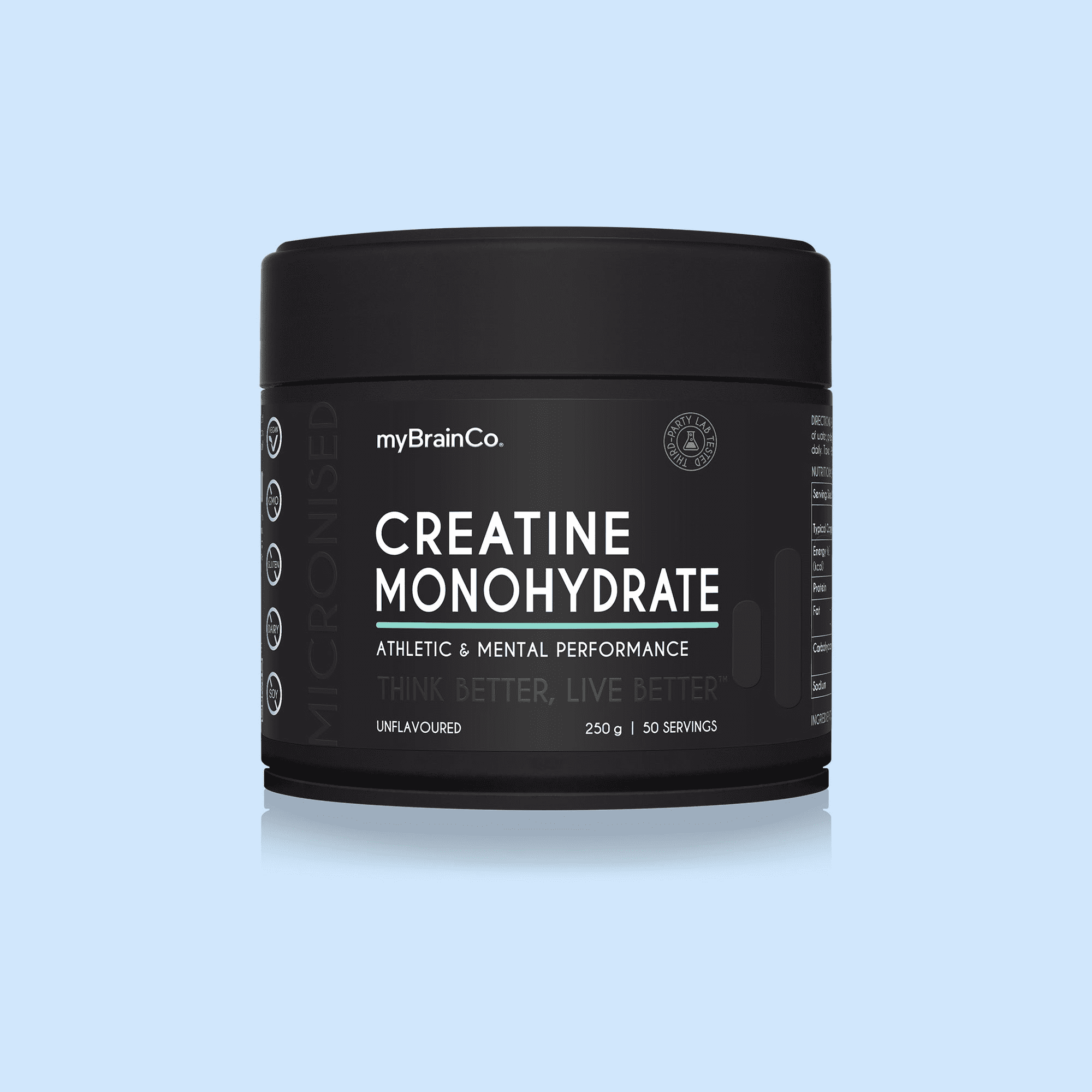
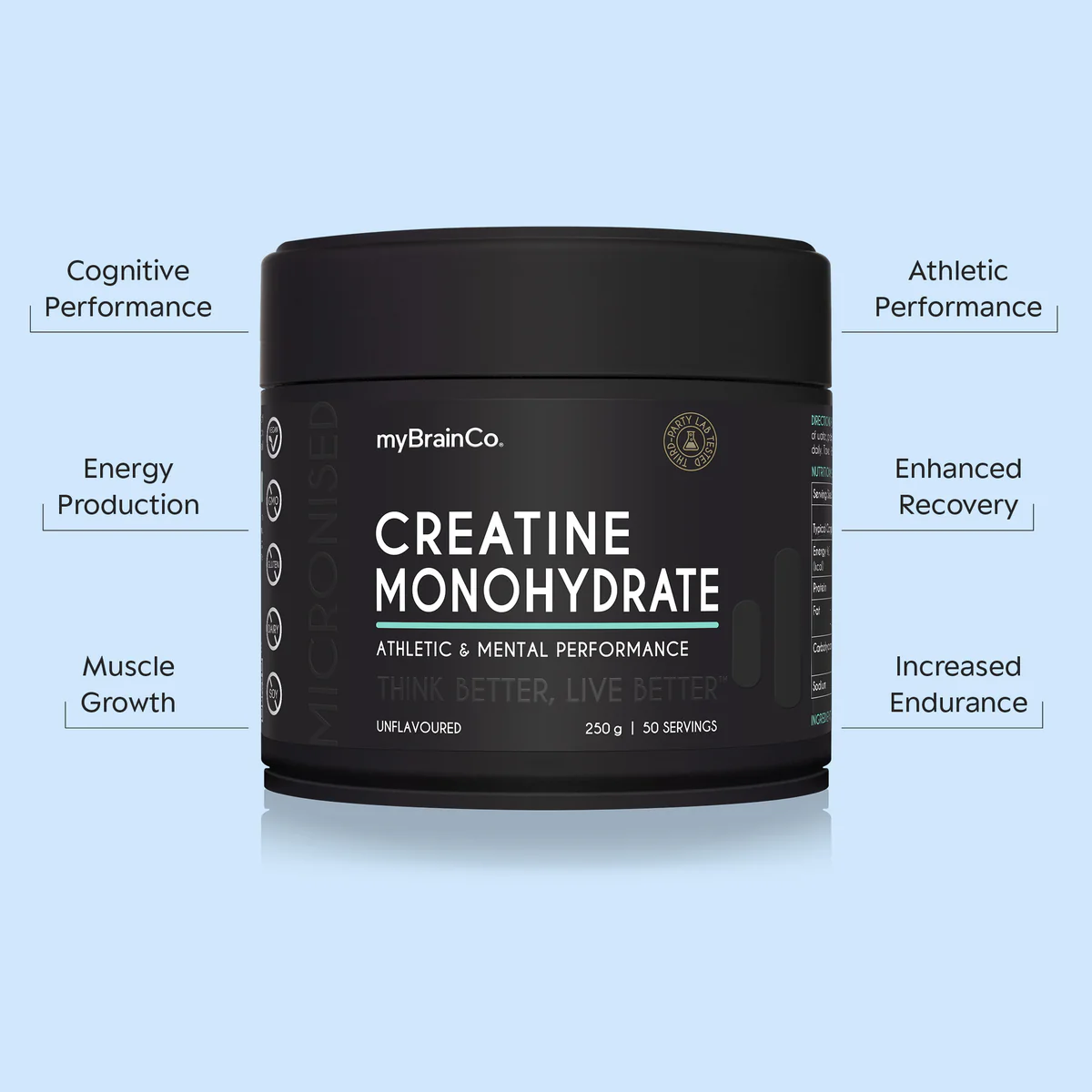
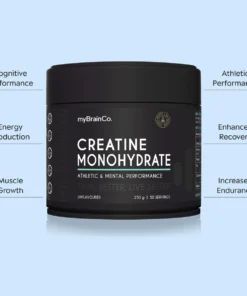
myBrainCo Micronised Creatine Monohydrate – 250g
Original price was: $27.80.$22.80Current price is: $22.80.

Creatine supplement: Creatine monohydrate, micronised, 3 g per serve.
myBrainCo unflavoured powder, 83 serves per 250 g pouch.
Only 12 left in stock
What is myBrainCo Micronised Creatine Monohydrate?
myBrainCo Micronised Creatine Monohydrate is an unflavoured powder providing 3 g of creatine monohydrate per serve, with 83 serves per 250 g pouch. The creatine is micronised for improved solubility. Each batch is independently tested via HPLC for purity and heavy metals at an APVMA-licensed Australian laboratory, and the product is certified carbon neutral under the Climate Active standard. It contains no fillers, sweeteners or flavouring.
Fairfield Nutrition Thoughts
myBrainCo Micronised Creatine Monohydrate comes as an unflavoured, unsweetened powder in a resealable 250 g pouch (83 serves). It mixes into cold water, juice, smoothies or other cold drinks. Store in a cool, dry place; always use a dry spoon and reseal after each use. Do not add to hot drinks. Keep the freshness packet inside the pouch and do not consume it.
Why This Formulation / How It Works
Standard creatine monohydrate has a significant practical limitation: it doesn’t dissolve well in water, which means inconsistent absorption and the need for loading protocols or higher doses to achieve steady-state levels. Micronising reduces particle size dramatically, improving water solubility and absorption kinetics. This allows you to achieve effective creatine saturation with simpler dosing (consistent daily intake rather than loading phases) and potentially lower total dose requirements.
The pharmaceutical-grade specification and independent HPLC testing for purity and heavy metals matter here. Cheaper creatine products sometimes contain significant impurities or contaminants that don’t affect efficacy but do add unnecessary metabolic burden. The cGMP manufacturing and Australian APVMA-licensed testing provide legitimate assurance of consistency batch-to-batch.
Role in ATP and Phosphocreatine Systems
Creatine functions as a phosphate buffer in muscle and brain cells. During high-intensity activity, ATP (the cell’s energy currency) depletes rapidly. Phosphocreatine donates its phosphate group to regenerate ATP, extending the duration you can maintain maximal effort. This is why creatine supplementation is most effective for activities lasting 6-30 seconds of maximal intensity (weightlifting sets, sprints, HIIT intervals) rather than endurance activities.
Cognitive Function and Brain Energy
Brain cells are metabolically expensive and rely heavily on consistent ATP availability. Creatine crosses the blood-brain barrier and accumulates in neurons and glial cells, where it functions identically to muscle tissue: buffering ATP and supporting energy production during cognitive demand. Research shows measurable improvements in working memory, reasoning speed, and mental fatigue resistance, particularly in tasks requiring sustained attention or rapid decision-making.
When to Consider This
This formulation makes sense if you’re:
Scenario 1: Engaged in regular strength training or HIIT workouts where you’re doing repeated high-intensity efforts (sets of heavy lifts, sprint intervals, plyometrics) and want to extend your performance capacity within those efforts.
Scenario 2: Working in cognitively demanding roles or studying for extended periods and interested in supporting mental clarity and working memory during sustained focus.
Scenario 3: Prioritising product quality and transparency, with preference for independently tested, pharmaceutical-grade supplements with documented purity and Australian manufacturing oversight.
Supplement strategy: Creatine is typically introduced once foundational training consistency is established. It’s most effective when combined with adequate protein intake and consistent resistance training or high-intensity activity. Many athletes add this after establishing basic training volume and nutrition, typically for 8-12 week blocks or ongoing depending on training cycles. It pairs well with protein supplementation and electrolyte support during training.
⚠️ Not suitable for: Children under 15 years, pregnant or breastfeeding women, individuals with pre-existing kidney or liver conditions without medical clearance, those taking medications that affect kidney function.
How to Use
Mix 1 scoop (approximately 3 g) into 150–200 mL of water, juice, a protein shake or your preferred cold drink. Take once daily. Use consistently as part of a healthy, varied diet and appropriate physical training or exercise program. Always use a dry spoon and reseal after each use. Do not add to hot drinks.
Ingredients
Per 3 g serve:
Creatine Monohydrate: 3 g
No other ingredients. Contains no fillers, sweeteners or flavouring.
Allergen information: Free from gluten, dairy, lactose, peanut, soy and egg.
Dietary certifications: Vegan. Gluten free. Dairy free.
Testing: Each batch is independently tested via HPLC for purity and heavy metals at an APVMA-licensed Australian laboratory. Certified carbon neutral under the Climate Active standard.
Common Questions
How do I mix this powder?
Mix 1 scoop (approximately 3 g) into 150–200 mL of cold water, juice, smoothie or another cold beverage. Do not add to hot drinks.
Does this need to be refrigerated?
No. Store in a cool, dry place. Always use a dry spoon and reseal the pouch after each use. Keep the freshness packet inside the pouch and do not consume it.
Is this product suitable for children?
Not suitable for children under 15 years of age.
Is this product suitable during pregnancy?
Not suitable for use during pregnancy or breastfeeding. Speak with your healthcare professional if you have any health concerns before use.
Warnings & Storage
Not a sole source of nutrition. Use in conjunction with a nutritious, varied diet and appropriate physical training or exercise program.
Not suitable for children under 15 years of age, pregnant or breastfeeding women.
Consult your healthcare professional before use if you are taking prescription medication, have a medical condition, or are planning surgery.
Do not eat the contents of the freshness packet. Keep it in the pouch to help maintain product freshness.
Keep out of reach of children.
Storage: Store in a cool, dry place. Always use a dry spoon and reseal after each use.
Always read the label and follow the directions for use.
| Weight | .402 kg |
|---|---|
| Dimensions | 9 × 9 × 14 cm |
| GTIN | 9.35E+12 |