
Supplement Strategy 101
Before you even start to supplement, consider this:
Before we think about supplements, it’s important to acknowledge something that often gets skipped.
Supplements cannot compensate for chronic issues in diet, lifestyle, or environment.
They can support the body, but they can’t override persistent stressors.
Areas that matter most include:
- Sleep quality and timing
- Food choices and consistency
- Regular movement
- Stress load and recovery
- Light exposure and daily rhythms
- Mold, toxins and environmental stresses
When these are significantly out of balance, adding more supplements usually leads to:
- diminishing returns
- temporary effects
- or a sense of “nothing really working”
This doesn’t mean everything has to be perfect before supplements are useful.
It does mean that supplements work best when these foundations are at least reasonably supported.
Think of supplementation as something that layers onto a functioning system, not something that fixes one that’s under constant strain.
Foundational, Targeted & Advanced
One of the most common patterns we see is people taking more supplements over time, spending more money, yet feeling no better — and sometimes worse.
The issue is rarely that supplements “don’t work”.
More often, it’s that they’re being added at the wrong level.
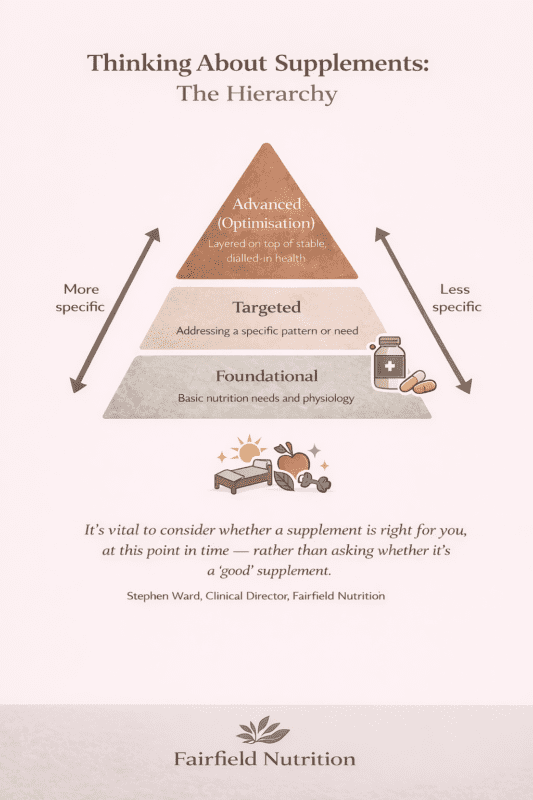
At Fairfield Nutrition, we think about supplementation as a hierarchy, not a checklist.
Most people benefit from starting lower than they expect (Foundational or Targeted), and moving up (including Targeted or Advanced) only when there’s a clear reason to do so.
It’s vital to think about whether a supplement is right for you, at this time, to achieve your goals.
Rather than asking ‘is this a good supplement?’, or following the hype.
Stephen Ward (Clinical director, Fairfield Nutrition)
Foundational supplements
Supporting the basics that everything else depends on
Foundational supplements are designed to support core nutritional needs and physiological processes that apply to most people.
They don’t target a specific condition or symptom. Instead, they help ensure that the body has what it needs to function reliably in the background.
Examples of foundational support include:
- Minerals and nutrients that are commonly low or poorly absorbed
- Broad nutritional support for energy production, nervous system function, or digestion
- Simple formulations intended for regular, ongoing use
Foundational supplements are often the least exciting — and the most important.
If foundations are weak or inconsistent, adding more specialised products on top rarely produces lasting results.
Most people do best when foundations are in place before anything more targeted is added.
Examples include Magnesium, Omega-3 (EPA/DHA) ,Vitamin D3 with K2, Zinc , B vitamin complex, Pre and Probiotics, Digestive Enzymes.
Targeted supplements
Used deliberately to address a specific pattern or need
Targeted supplements are designed to support a particular system, function, or goal.
They make the most sense when there is:
- a clearly identified issue
- a specific reason for choosing that product
- an understanding of what role it’s meant to play
Examples might include:
- Digestive support chosen for a known pattern
- Nutrients used to support a particular stage of life or stress load
- Shorter-term support layered on top of foundations
Targeted supplements work best when they are:
- chosen intentionally
- reviewed periodically
- not treated as permanent “add-ons” by default
Adding multiple targeted products without a clear rationale often leads to confusion rather than clarity.
Advanced supplements
More specialised, not “better”
Used once foundations are in place and there are no major imbalances to address
Advanced supplements are often misunderstood.
They’re not necessarily “stronger”, more aggressive, or more medical.
In many cases, they’re used after the body is functioning relatively well — not when something is clearly wrong.
This category is best thought of as optimisation-focused, rather than corrective.
Advanced supplements are typically used when:
- core nutrition is adequate
- lifestyle and recovery are reasonably stable
- there are no obvious deficiencies or unresolved health issues
- the goal is to refine, maintain, or optimise how you feel
Examples of optimisation goals might include:
- supporting healthy ageing or longevity markers
- improving resilience, recovery, or cognitive performance
- fine-tuning energy, sleep quality, or exercise response
In this context, advanced supplements are additive rather than compensatory.
They tend to work best when:
- used selectively
- layered on top of a stable baseline
- reviewed periodically rather than taken indefinitely by default
When advanced supplements don’t make sense
Advanced supplements are often disappointing when:
- foundational needs haven’t been addressed
- targeted support is still clearly required
- lifestyle stressors are dominating physiology
In these situations, optimisation tends to be fragile or short-lived, because the system underneath isn’t ready to be optimised.
In other words, optimisation works best when there’s something stable to optimise.
A common mistake we see
A very common pattern looks like this:
Symptoms → add a targeted supplement
Partial relief → add another
Plateau → add something “stronger”
Over time, this often results in:
- long supplement lists
- higher monthly spend
- less confidence about what’s actually helping
The goal isn’t to keep climbing the ladder.
The goal is to use the lowest level that meaningfully supports you, and only move up when there’s a clear reason.
How this framework is meant to be used
This framework isn’t about restriction or minimalism for its own sake.
It’s about:
- relevance over volume
- clarity over accumulation
- making supplements work with your body, not around it
When browsing products on our site, the Foundational, Targeted, and Advanced labels are there to help you pause and ask:
- Is this a base I’m missing?
- Is this addressing something specific I’ve identified?
- Or am I adding complexity without a clear reason?
If you’re ever unsure, it’s usually worth stepping down a level — not up.