
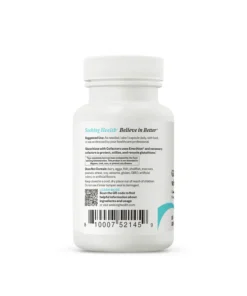
Seeking Health Glutathione with Cofactors (60 Lozenges)
$92.80

Glutathione supplement: S-acetyl-L-glutathione (Emothion®) with selenium, riboflavin, and molybdenum cofactors.
Seeking Health lozenge formulation with Albion® mineral forms and clinically researched Emothion® glutathione.
Only 2 left in stock
Ships same business day from Melbourne (orders before 2pm)

Christmas & Holiday Dispatch
Same-day dispatch on all orders placed before 2pm (Mon–Fri).
We’re sending orders every day over Christmas, except Christmas Eve and public holidays.
Enjoy Free Express shipping on orders over $175 - we recommend Express during the festive period.
What is Seeking Health Glutathione with Cofactors and who is it for?
Glutathione with Cofactors is a lozenge-form glutathione supplement that pairs S-acetyl-L-glutathione (as Emothion®) with three specific cofactors: selenium, riboflavin, and molybdenum. It’s designed for people who want targeted glutathione support but have found other forms difficult to tolerate, impractical to take, or simply ineffective. The small, taste-free lozenge format makes it easy to carry and take as needed rather than on a rigid daily schedule.
Where this stands out from standard glutathione products is the cofactor inclusion. Glutathione doesn’t work in isolation – it requires selenium to activate the GPX enzyme that uses it, riboflavin to recycle it via the GSR enzyme, and molybdenum to support the SUOX enzyme that handles sulfite byproducts. People who experience headaches or irritability from glutathione supplements often lack these supporting nutrients, not the glutathione itself. This formulation addresses that gap directly.
Fairfield Nutrition Thoughts
Glutathione is one of those compounds that gets recommended broadly but delivered poorly. Most oral glutathione is broken down in the gut before it reaches circulation, and many people who try glutathione supplements either notice nothing or react badly – headaches, irritability, disrupted sleep. The reaction issue in particular is something we see regularly in practice, and it’s almost always a cofactor problem rather than a glutathione problem.
Why This Formulation / How It Works
Most glutathione supplements deliver reduced L-glutathione, which is unstable in the digestive tract and largely broken down before absorption. The S-acetyl form used here (Emothion®) has an acetyl group attached that helps it survive the journey through the gut intact, with the acetyl group removed intracellularly once absorbed. This is a meaningful formulation difference rather than a marketing distinction.
The cofactor inclusion is what genuinely sets this apart. Glutathione doesn’t function as a standalone molecule – it’s part of a recycling system that depends on specific enzymes, and those enzymes depend on specific nutrients. Without sufficient selenium, the GPX enzyme that uses glutathione to neutralise peroxides can’t function properly. Without riboflavin, the GSR enzyme can’t convert oxidised glutathione back to its active reduced form. Without molybdenum, the SUOX enzyme that processes sulfite byproducts from glutathione metabolism is impaired – and sulfite accumulation is the most common reason people react badly to glutathione supplementation. Addressing all three alongside the glutathione itself reflects how the system is actually designed to work.
Role of S-Acetyl Glutathione in Cellular Antioxidant Pathways
Glutathione is found in high concentrations inside cells, where it functions as a primary electron donor in antioxidant reactions. The GPX enzyme uses glutathione to neutralise hydrogen peroxide and lipid peroxides, converting them to water and alcohols. Once oxidised in this process, glutathione is recycled back to its active form by the GSR enzyme – a step that requires riboflavin (as FAD) as a cofactor.
Selenium’s Role in Glutathione Peroxidase Activity
Selenium is incorporated directly into the active site of GPX enzymes as selenocysteine – without it, the enzyme cannot catalyse the reaction that uses glutathione. This means that supplementing glutathione without adequate selenium may provide the substrate without the enzyme capacity to use it. The Albion® chelate form used here is selected for absorption characteristics over standard inorganic selenium forms.
Molybdenum and Sulfite Metabolism
When glutathione is metabolised, sulfite is produced as a byproduct. The SUOX enzyme converts sulfite to sulfate for excretion, and molybdenum is the mineral cofactor that SUOX requires to function. In people with low molybdenum status, sulfite can accumulate, producing symptoms including headaches and irritability that are commonly attributed to the glutathione itself. Including molybdenum (as Albion® chelate) directly addresses this mechanism.
When to Consider This
This formulation provides nutritional support for glutathione pathways. It makes sense if you’re:
- Regularly exposed to environmental chemicals – exhaust, chlorine, new building materials, cleaning products, paints, or fragrances – and want to provide nutritional support for your body’s antioxidant systems during those exposures.
- Someone who has tried glutathione supplements before and experienced headaches, irritability, or sleep disruption – the cofactor inclusion here specifically addresses the sulfite pathway that drives most of these reactions.
- Working with a practitioner on liver wellness or methylation support, and glutathione has been identified as a relevant addition to your protocol.
- Looking for a travel-friendly, refrigeration-free option that you can take as needed rather than on a fixed daily schedule.
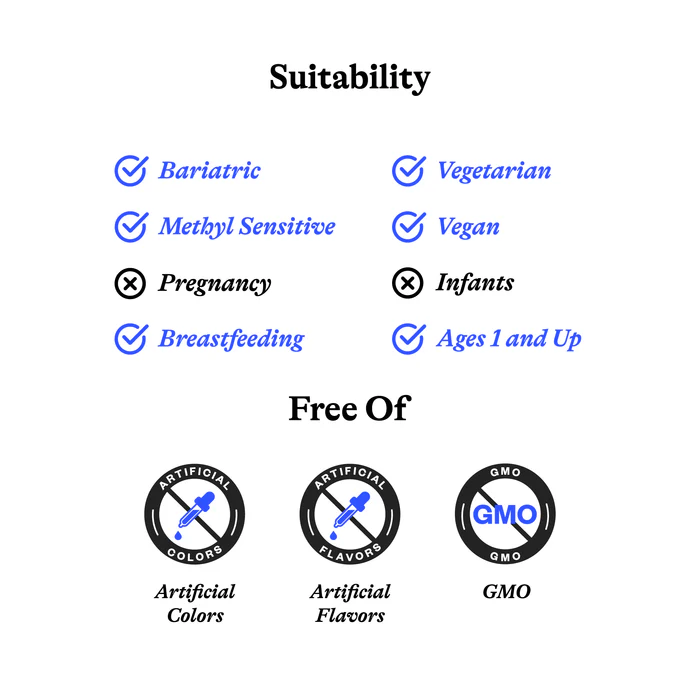
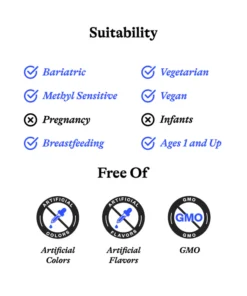
- Vegetarian, vegan, or post-bariatric, or breastfeeding – this formulation is noted as suitable across these contexts.
Supplement strategy: Many people introduce this alongside foundational antioxidant support once dietary foundations are in place. It’s commonly used on an as-needed basis rather than daily, with dose adjusted to exposure load. Seeking Health notes it pairs well with Liver Nutrients, Calcium D-Glucarate, and Bile Nutrients for more comprehensive liver wellness protocols, though it works independently.
⚠️ Not suitable for: Children under 4 years. Consult your healthcare practitioner before use if pregnant (breastfeeding is noted as suitable). Do not use if the inner tamper seal is damaged.
How to Use
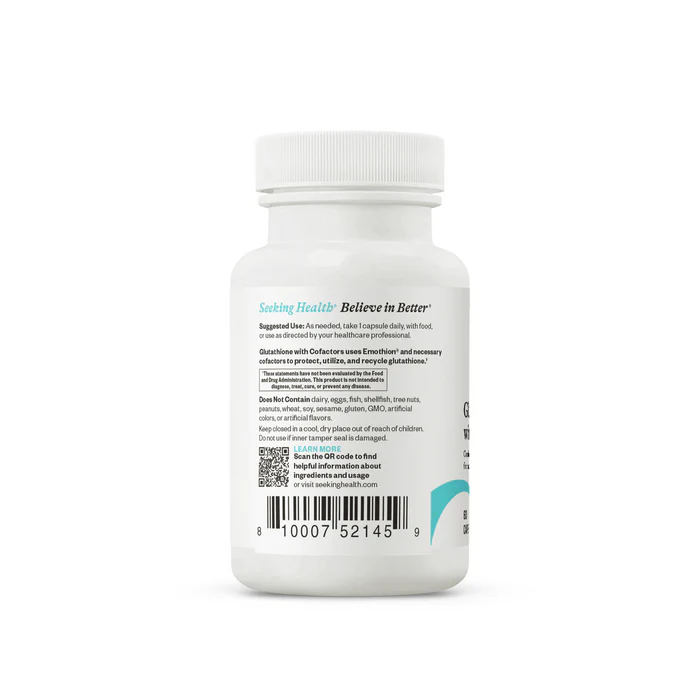
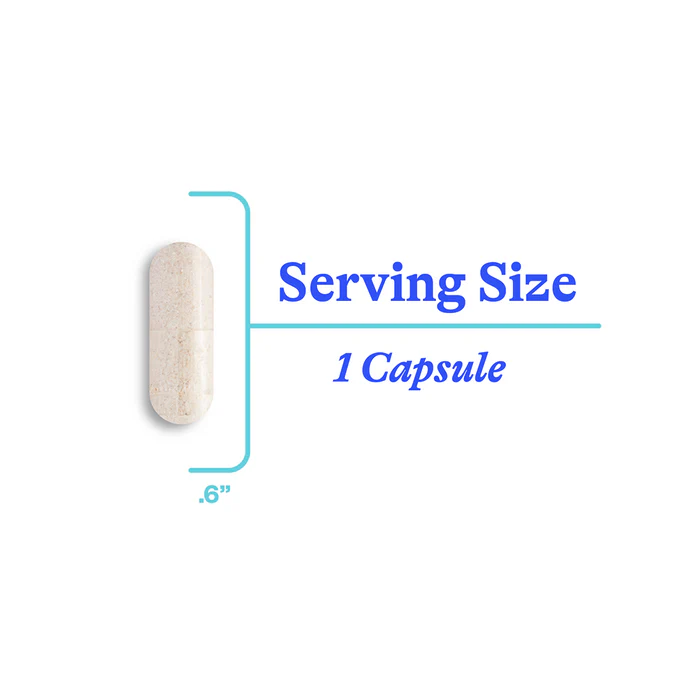
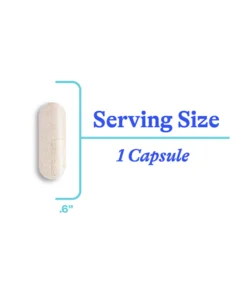
Take 1 lozenge as needed, with food, at any time of day. Seeking Health’s guidance is to adjust dose based on your exposure load on a given day rather than taking a fixed daily amount – higher exposure days may warrant a lozenge, while low-exposure days may not require any.
Avoid taking within 2 hours of bedtime, as glutathione may interfere with sleep in some people. If you notice headaches, irritability, or sleep disruption, reduce frequency or stop for a few days – these are signs of taking more than your system currently needs, not a reason to avoid the product entirely.
Seeking Health recommends pairing with Liver Nutrients, Calcium D-Glucarate, and Bile Nutrients for broader liver wellness protocol support, though Glutathione with Cofactors works well as a standalone product.
Ingredients
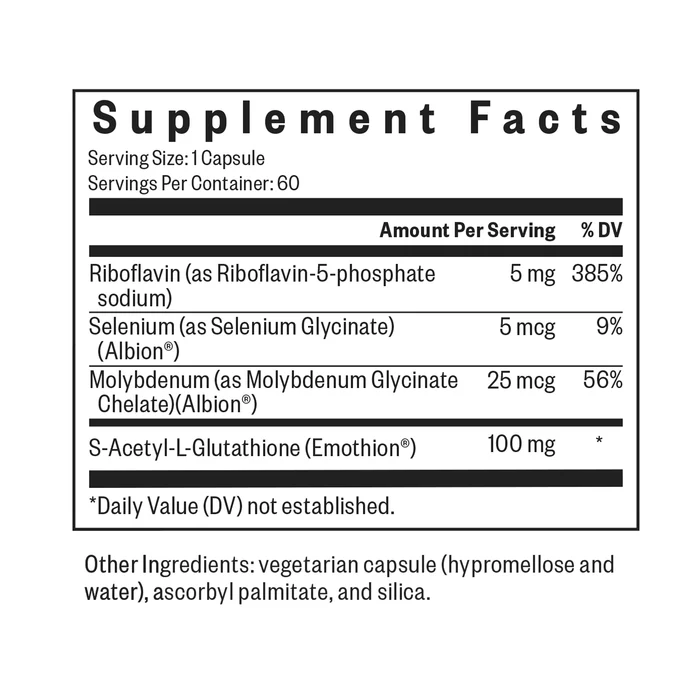
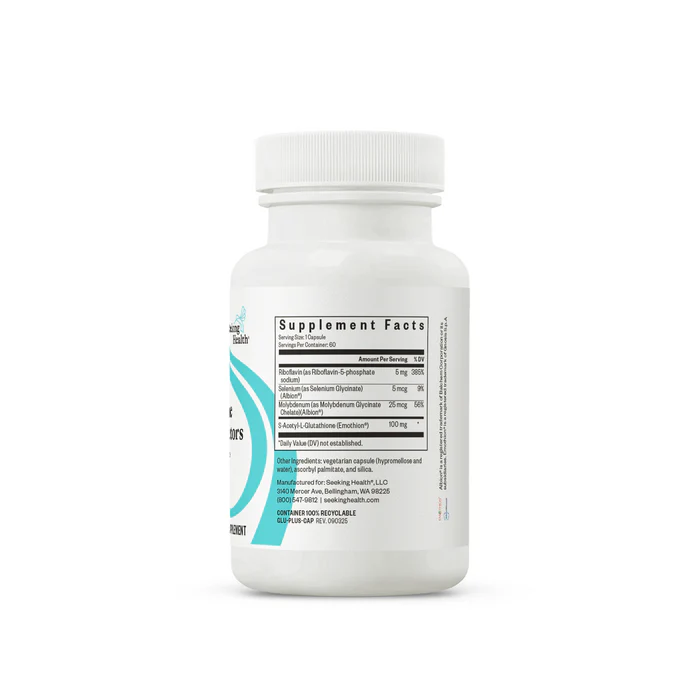
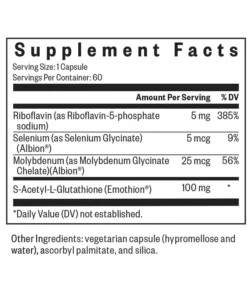
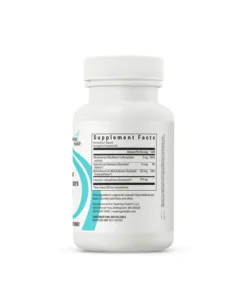
Per 1 lozenge:
S-Acetyl-L-Glutathione (as Emothion®)
Selenium (as Albion® chelate)
Riboflavin (Vitamin B2)
Molybdenum (as Albion® chelate)
Note: Exact milligram and microgram amounts per lozenge were not confirmed from available manufacturer data. Please refer to the product label for complete supplement facts.
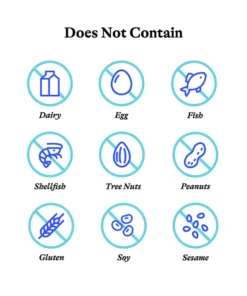
Allergen information: Free from common allergens. Suitable for vegetarians and vegans.
Common Questions
How is S-acetyl glutathione different from regular glutathione supplements?
Standard reduced glutathione (L-glutathione) is largely broken down in the digestive tract before it can be absorbed. The S-acetyl form has an acetyl group that helps it survive this process, with the acetyl group removed once it’s inside cells. Research on the Emothion® form specifically supports its oral stability and cellular uptake compared to unmodified glutathione.
Why does this contain selenium, riboflavin, and molybdenum?
These three nutrients are required for the enzymes that use and recycle glutathione. Selenium activates GPX (the enzyme that uses glutathione in antioxidant reactions), riboflavin enables GSR (which recycles oxidised glutathione back to its active form), and molybdenum supports SUOX (which processes sulfite byproducts from glutathione metabolism). Without these, supplemental glutathione has less enzymatic capacity to work with.
I tried glutathione before and got headaches. Will this be different?
Possibly. Headaches and irritability from glutathione are commonly linked to sulfite accumulation when the SUOX enzyme lacks sufficient molybdenum, or to elevated glutamate when doses are too high. The molybdenum inclusion here directly addresses the sulfite pathway. Starting with a lower frequency and adjusting based on how you feel is the recommended approach regardless.
Can children take this?
Seeking Health lists this as suitable from age 4 and up. As with any supplement for children, checking with your healthcare practitioner first is worthwhile.
Does this need to be refrigerated?
No. Store in a cool, dry place away from direct sunlight. The lozenge format and lack of refrigeration requirement are part of what makes it practical for travel.
Warnings & Storage
Do not use if: Under 4 years of age. Inner tamper seal is damaged.
Cautions: If pregnant, consult your healthcare practitioner before use (noted as suitable for breastfeeding). If you experience headaches, irritability, or sleep disruption, reduce frequency or discontinue use. Avoid taking within 2 hours of bedtime. If taking medications or managing a health condition, consult your healthcare practitioner before use.
Storage: Store in a cool, dry place away from direct sunlight and out of reach of children. Refrigeration not required.
Always consult your healthcare professional before use if you have any pre-existing conditions or are taking medications.
| Weight | 0.045 kg |
|---|---|
| Shipping and Returns | Standard delivery times of 1-7 business days are to be expected. Free express delivery for orders over $175. No questions asked returns and refund within 30 days. |
Brand
Seeking Health
Seeking Health Australia
Practitioner-grade supplements designed for clarity, tolerance, and individual needs Seeking Health is a practitioner-focused supplement brand developed to support individual nutritional needs with a strong emphasis on formulation clarity and tolerance. Founded by Dr Ben Lynch, Seeking Health is best known for its work in areas such as methylation, histamine balance, gut health, and immune support. The brand offers a broad range of supplements — from everyday nutritional foundations to more targeted products for people who don’t respond well to standard formulations. At Fairfield, we stock a wide selection of Seeking Health products used by practitioners and individuals who want more control and predictability in how supplements affect them.What makes Seeking Health different
Designed for people who don’t tolerate “standard” supplements well
Many supplements are formulated with the assumption that everyone responds the same way. In practice, this often isn’t true. Seeking Health products are commonly chosen by people who:- feel overstimulated by certain vitamins (especially B vitamins)
- react poorly to additives or excipients
- need more flexibility around dose and form
- want supplements that can be adjusted rather than “one-size-fits-all”
How to think about using Seeking Health products
The range naturally divides neatly into the categories we like to use:- foundational products that suit many people and can be used long-term
- targeted products designed for specific patterns, sensitivities, or short-term support
🟢 Foundational Seeking Health products
Suitable for many people, including longer-term use Foundational products are typically used to support:- baseline nutrient intake
- nervous system and muscle function
- digestion and fat absorption
- general immune and metabolic health
- Optimal Multivitamin – comprehensive daily nutrient support with careful balance
- Multivitamin One – simplified daily multivitamin for those wanting fewer ingredients
- Optimal Magnesium – well-tolerated magnesium support for muscles and nervous system
- Vitamin C Plus – foundational antioxidant and immune support
- Vitamin D3 – baseline vitamin D support when sun exposure is limited
- Vitamin D3 + K2 – combined fat-soluble vitamin support for bone and cardiovascular health
- Fish Oil – omega-3 fatty acids for general inflammatory balance
- Digestive Enzymes – broad-spectrum enzyme support to assist digestion
- Optimal Man – foundational nutrient support formulated for male health needs
🟡 Targeted Seeking Health products
Best used for specific sensitivities or clearer needs A large part of the Seeking Health range is designed for more specific situations, particularly where standard supplements haven’t worked well. Targeted products are commonly used to support areas such as:- histamine sensitivity or intolerance
- methylation-related nutrient needs
- immune regulation
- gut-related reactivity
- stress and neurotransmitter balance
- added on top of foundations
- used with clearer intent
- reassessed rather than taken indefinitely
A practical note on individual response
Seeking Health products are intentionally flexible — which means responses can vary. Some people notice benefits quickly. Others may need to:- adjust dose
- simplify what they’re taking
- allow more time between introducing products
Why buy Seeking Health from Fairfield
- Australian-based, stocked locally — dispatched from Melbourne
- Fast shipping on in-stock items (same-day dispatch when ordered before 2pm)
- Wide Seeking Health range available in Australia
- Clear, conservative guidance — we prioritise understanding over upselling
Seeking Health products available at Fairfield
Browse the Seeking Health products we stock below. If you’re new to the brand, many people begin with foundational support before exploring more targeted options as needed.