
The Fairfield Framework
A clearer way to think about supplements, health decisions, and where to begin
Here’s something I’ve noticed after years in practice: the people who struggle most with supplements usually aren’t the ones who know too little. They’re often the ones trying to make sense of too many competing ideas.
One article says probiotics are essential. Another says they’re overhyped. One practitioner recommends ten supplements immediately. Another says throw them all out and eat more vegetables. Meanwhile, your inbox is full of wellness content warning you about deficiencies you’ve never even heard of.
So you buy things. You try things. Nothing feels like it’s working. And now you have a shelf full of half-finished bottles and no clearer sense of where to begin.
Sound familiar?
One of the biggest challenges in modern health isn’t lack of information. It’s difficulty knowing what actually matters first.
One pattern I’ve seen repeatedly is people pursuing increasingly advanced solutions while the foundations remain largely untouched. A new supplement, a more sophisticated protocol, a deeper lab test — all reasonable in isolation, but often added before the basics are actually in place.
The goal isn’t to become dependent on increasingly complicated health advice. It’s to become more capable of navigating health decisions for yourself.
Over time, I’ve found that the people who make the best health decisions aren’t necessarily the ones who know the most. They’re the ones who have a framework for deciding what deserves attention, what can probably wait, and what the next sensible step looks like.
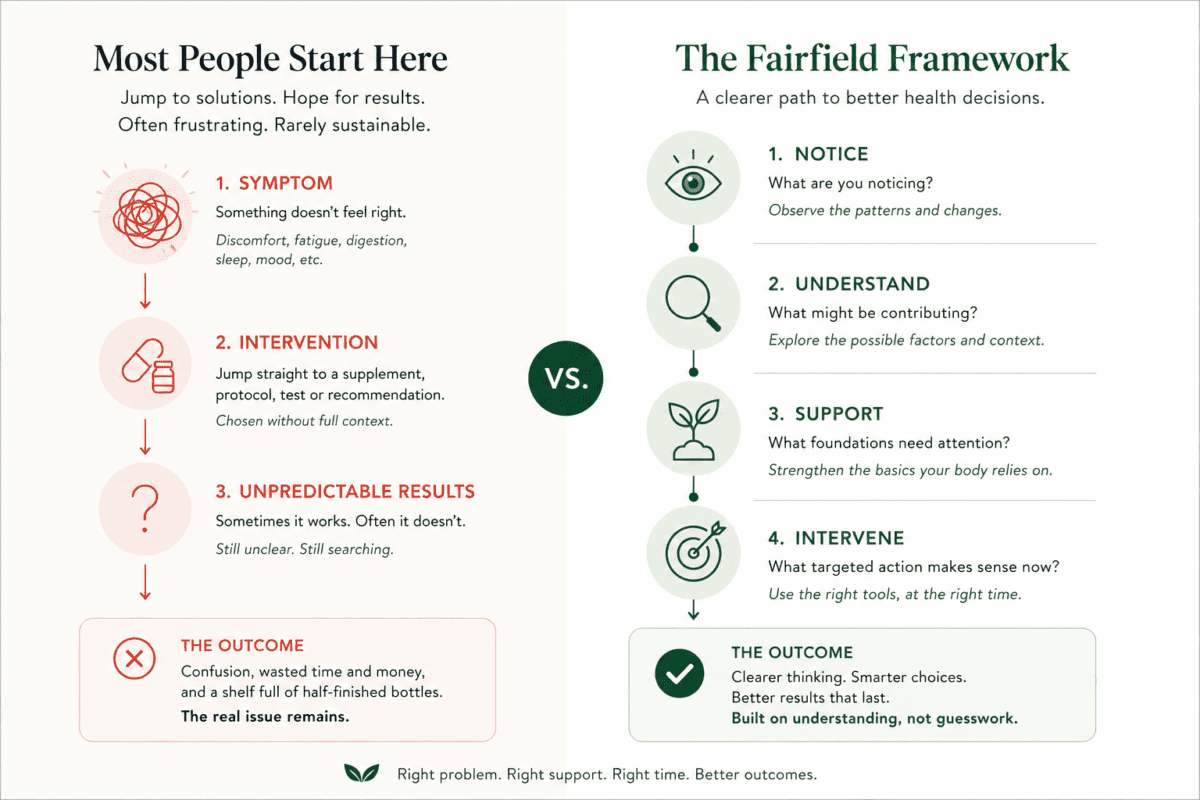
Most People Start Here
When something doesn’t feel right, most people naturally look for a solution. A symptom appears, a supplement is suggested, a protocol is recommended, a test is ordered. Sometimes that works. Often it doesn’t — not because the intervention was wrong, but because the earlier steps were skipped.
This is where much of the frustration around supplements comes from. The intervention may have been reasonable, but it was chosen before enough attention had been given to understanding the situation.
The Fairfield Framework is simply a way of making sure we move in the right order. The honest answer, the one that’s not particularly exciting, is that most people benefit more from improving their foundations than from adding more supplements.
That means things like:
- Consistent sleep, not perfect sleep, just consistent
- Eating enough protein and whole food
- Blood sugar that isn’t constantly spiking and crashing
- Digestive function that’s actually working
- Stress that isn’t chronically overwhelming your system
- Movement that’s regular rather than heroic
- Good water, light and clean air
I’m not saying this to dismiss supplements. Some of them genuinely matter. But no supplement compensates well for chronically poor sleep, a highly processed diet, or ongoing stress that’s never addressed.
Trying to optimise on top of a shaky foundation usually produces disappointing results. Then people conclude that supplements don’t work, when the real issue is sequencing.
Foundations are not boring. They’re where physiology becomes more stable. And that stability is often what allows everything else to work more effectively.
The Fairfield Framework
The framework moves through four stages: Notice → Understand → Support → Intervene. Each stage informs the next. When people get stuck, it’s often because they’ve tried to intervene before spending enough time noticing, understanding, or supporting the foundations.
Notice
Before deciding what to do, it helps to step back and notice what is actually happening.
What patterns keep showing up? What symptoms are recurring? What feels different compared to six months or a year ago?
Perhaps you’ve noticed:
- Digestive symptoms that seem increasingly unpredictable
- Energy that feels lower than it should
- Sleep that leaves you less recovered than expected
- Food reactions that weren’t there previously
- Stress that feels harder to bounce back from
- A general sense that your resilience isn’t what it once was
The goal isn’t to diagnose yourself. It’s simply to pay attention before jumping to conclusions. Symptoms aren’t diagnoses — but they’re rarely meaningless either. They’re often useful information that can help point your attention in the right direction.
Most people either ignore signals for too long or become fixated on them. Neither is particularly useful. The goal isn’t to worry about every symptom. It’s simply to notice patterns before deciding what they mean.
Understand
Once you’ve noticed a pattern, the next question isn’t “what should I take?” It’s “what might be contributing to this?”
This is where health often becomes confusing. The same symptom can have many different contributing factors. Bloating might relate to digestion, meal habits, food choices, stress, microbiome changes, antibiotic history, or several of those at once. Fatigue could involve sleep, nutrition, recovery, blood sugar regulation, stress, workload, or underlying health issues.
This is one reason why health advice can seem so contradictory — different people are often describing different causes behind similar symptoms.
The goal isn’t perfect certainty. It’s enough understanding to make better decisions. When people skip this step, they often end up collecting interventions without ever developing a coherent picture of what they’re actually trying to address. Sometimes understanding comes from paying closer attention to patterns over time. Sometimes additional information from testing — such as a GI-MAP, DUTCH hormone panel or SIBO breath test — can help narrow the questions worth exploring. Testing doesn’t create understanding by itself. Good testing narrows uncertainty and helps you ask better questions.
Understanding creates context. And context is what turns random health advice into something useful.
Support
This is where foundations come in — and it’s the stage most people underestimate, and the one we think matters most.
The honest answer, the one that’s not particularly exciting, is that most people benefit more from strengthening their foundations than from immediately reaching for highly targeted interventions. That includes things like:
- Consistent sleep (not perfect sleep, just consistent)
- Adequate protein and whole foods
- Blood sugar stability
- Digestive function that’s actually working
- Stress management
- Regular movement
- Good water, light, and air quality
These aren’t things you do before focusing on health. They are the foundations that health is built upon. When foundations are neglected, almost every system in the body becomes harder to support effectively.
The uncomfortable truth is that most people who come to us have spent more time searching for the right intervention than building the foundations that would make any intervention actually work. A better probiotic won’t compensate for chronically poor sleep. More specialised supplementation makes more sense when the fundamentals are already being addressed.
But support isn’t limited to lifestyle alone. Modern life can make some foundational nutritional needs surprisingly difficult to meet consistently — and this is where foundational supplements can genuinely earn their place. Unlike highly targeted products designed for specific situations, foundational supplements tend to support systems and processes that are broadly relevant to many people.
Examples might include magnesium, omega-3s, vitamin D, electrolytes, probiotics, prebiotics and broader nutritional products.
These aren’t the supplements generating excitement on social media. But they often support the foundations upon which everything else depends.
The most common pattern we see isn’t people who are missing a cutting-edge intervention. It’s people trying to optimise before they have stabilised. Foundations are not boring — they’re where health becomes more stable, more resilient, and often surprisingly simpler. And that stability is often what makes everything else actually work.
Intervene
Once you’ve noticed what’s happening, developed some understanding, and strengthened the foundations, targeted interventions become much easier to evaluate.
This is where supplements, testing, and more specific strategies can become genuinely useful — not as shortcuts or magic bullets, but as tools. The question becomes: “What intervention makes sense given everything I’ve learned so far?” Sometimes that’s a supplement. Sometimes it’s testing. Sometimes it’s simplifying what you’re already doing. Sometimes it’s working with a practitioner to investigate something more deeply.
The goal isn’t to do more. It’s to intervene more intelligently. When interventions are chosen within the context of the previous three stages, they tend to be more relevant and much easier to evaluate.
Where Supplements Fit
One of the most useful shifts I’ve seen in practice is when people stop thinking about supplements as a shopping list and start thinking about them as a hierarchy. Some are broadly relevant to modern life. Others only make sense in specific contexts. And some are genuinely interesting but often unnecessary for anyone who hasn’t addressed the basics.
That’s why we organise our products into three broad categories.
| Category | Best Thought Of As |
|---|---|
| Foundational | Supporting systems and processes that many people benefit from strengthening. |
| Targeted | Products with more specific ingredients or formulations that may be relevant to particular nutritional needs or circumstances. |
| Advanced | Specialised or optimisation-focused approaches that generally make most sense once foundations are already in place. |
Remember, advanced doesn’t mean better – It means more specific. For many people, there is greater value in strengthening foundations before exploring optimisation.
More Is Usually Not Better
Modern wellness culture often implies that accumulating more supplements is a sign of taking your health seriously. In practice, I often see the opposite.
Someone arrives with twelve or fifteen supplements — most added for sensible reasons, some from a podcast, others from social media, a few recommended years ago and never stopped. The problem is they no longer know what’s helping, what’s unnecessary, or what to stop. The protocol itself has become another source of stress.
When I see a very long supplement list, my first instinct is often to simplify. Sometimes adding something makes sense. Sometimes the most useful decision is removing things and seeing what actually changes. What we’re aiming for is clarity, intentionality, good sequencing, and understanding why something is being used — not a protocol you’re simply hoping will work.
Our Philosophy
Our aim is not simply to help people choose supplements. It’s to help them become better at making health decisions.
Most supplement stores want you to buy more. We’d rather you buy less, but better — and understand why. Sometimes the right decision is adding a supplement. Sometimes it’s strengthening a foundation. Sometimes it’s recognising that no intervention is needed right now.
That means helping people understand what matters most, approach supplementation with greater clarity and confidence, and build genuine autonomy in how they navigate their health over time — rather than dependence on complicated protocols or endless optimisation.
We believe supplements are best understood as tools that fit within a broader framework of health support, not isolated fixes or shortcuts. The goal isn’t optimisation for its own sake. It’s building greater resilience, clearer thinking, and the kind of health literacy that stays useful long after any single supplement does.