
Akkermansia: What, Why and Is It Right for You?
If you’ve been reading about gut health, metabolic research, or insulin regulation, you’ve probably come across Akkermansia muciniphila. It’s frequently mentioned in studies (and social media!) on gut barrier integrity, inflammation, and metabolic health.
But what is Akkermansia?
And more importantly — when does it make sense to consider it?
Well, when we run microbiome testing, we find low or undetectable levels of Akkermansia are very common.
That doesn’t mean everyone should supplement it. And it certainly doesn’t mean it’s appropriate in all situations. In fact, the research highlights clear contexts where Akkermansia may be unhelpful — or even contraindicated.
This article explains what Akkermansia does, why it’s different from typical probiotics, when it may be useful, and when it’s better avoided.
Akkermansia at a Glance
Akkermansia may be worth considering if you:
- Have insulin resistance, prediabetes, type 2 diabetes, or stubborn weight issues
- Have otherwise stable digestion but signs suggesting gut barrier dysfunction
- Show chronic low-grade inflammation without a clear cause
- Have addressed foundational gut support but still feel something is missing
Avoid or use caution if you have:
- Active inflammatory bowel disease (Crohn’s disease or ulcerative colitis)
- An active gut infection
- Are in the immediate post-antibiotic recovery phase
- Diagnosed Parkinson’s disease or multiple sclerosis (requires practitioner oversight)
- PCOS or endometriosis with significant gut symptoms (individual assessment needed)
Microbiome testing can confirm Akkermansia levels, but it isn’t mandatory if the broader clinical picture clearly fits.
What Is Akkermansia?
Akkermansia muciniphila is a naturally occurring bacterium found in the human gut. What makes it unusual is where it lives.
Rather than residing mainly in the gut lumen like most probiotic organisms, Akkermansia lives in the mucin layer — the gel-like coating that lines the intestinal wall.
This layer isn’t just passive protection. It’s a dynamic interface between the contents of the gut and the immune system. The thickness, turnover, and integrity of this mucin layer play a central role in gut barrier function.
Akkermansia interacts directly with this layer, placing it in a fundamentally different category from typical probiotic strains.
Why Akkermansia Is Different from Typical Probiotics
Most probiotics — Lactobacillus, Bifidobacterium, Saccharomyces — primarily act within the gut lumen. They:
- Compete with other microbes and so can reduce number of problematic bacteria
- Produce useful metabolites like short chain fatty acids (SCFAs)
- Support digestion and microbial diversity by shifting the microbiome in a more healthful direction
Akkermansia doesn’t work like that.
It colonises the mucin layer close to the intestinal wall and uses mucin as part of its metabolism. While that can sound concerning, the prevailing hypothesis — supported by animal and early human data — is that this activity stimulates mucin turnover and production, helping maintain a healthier, more intact mucus barrier over time, and therefore preventing gut permeability or ‘leaky gut’.
The key distinction is this:
Akkermansia is being studied for its relationship with the gut lining itself, not for general digestive support.
That makes it a more targeted intervention than standard broad-spectrum probiotic.
Why Akkermansia Has Only Recently Become Available as a Supplement
Akkermansia has been studied for more than a decade. Researchers have long known it exists and appears metabolically relevant.
What held things back wasn’t lack of interest — it was feasibility.
Akkermansia is:
- Highly oxygen-sensitive
- Difficult to culture
- Historically unstable outside laboratory conditions
Only recently has manufacturing technology advanced enough to produce Akkermansia in a form that can survive production, storage, and digestion.
This means human supplementation is relatively new. While the research is promising and expanding, we don’t yet have decades of widespread clinical use. That’s important context when deciding whether and how to use it.
How Akkermansia Interacts with the Gut Lining
The intestinal lining is protected by a mucus layer made up of mucins. This layer separates gut contents from the epithelial cells and immune system beneath.
Akkermansia lives within this layer. It breaks down mucin as an energy source, and in doing so appears to stimulate the gut to produce more mucin — leading to ongoing renewal rather than erosion.
There’s also evidence that Akkermansia’s metabolic by-products interact with immune cells in the gut wall, though these mechanisms are still being clarified.
What makes Akkermansia interesting isn’t general “gut health”. It’s where it operates: right at the interface between gut contents and immune surveillance.
What the Evidence Actually Shows
A 2024 clinical trial published in Cell Metabolism examined Akkermansia supplementation in 58 participants with overweight or obese type 2 diabetes over 12 weeks.
The findings were notable:
Akkermansia supplementation led to significant reductions in body weight, fat mass, and HbA1c
Benefits were most pronounced in participants with low baseline Akkermansia levels
In participants who already had adequate levels, colonisation was limited and metabolic benefits were minimal
This pattern makes biological sense. Introducing Akkermansia appears most effective when it addresses a genuine gap rather than adding more of something already present.
Earlier studies in overweight and obese individuals found that pasteurised Akkermansia improved insulin sensitivity, reduced cholesterol, and led to modest weight loss compared to placebo.
Across studies, a consistent pattern emerges: Akkermansia supplementation can produce meaningful metabolic benefits, particularly in insulin-resistant or metabolically compromised individuals — and particularly when baseline levels are low.
Colonisation alone doesn’t guarantee benefit; context determines whether that presence is metabolically meaningful.
When Akkermansia May Be Appropriate
Based on current research and clinical experience, Akkermansia may be relevant in cases involving:
Metabolic dysfunction Insulin resistance, prediabetes, type 2 diabetes, or weight that doesn’t respond to reasonable diet and lifestyle changes.
Gut barrier concerns with otherwise stable digestion A history of food sensitivities or inflammatory patterns suggesting barrier dysfunction, where basic digestive tolerance is already stable.
Chronic low-grade inflammation Elevated inflammatory markers without a clear driver, where gut permeability may be contributing.
Persistent symptoms despite good foundations Situations where diet, digestion, and basic supplementation are in place, but progress has plateaued.
Appetite dysregulation and persistent cravings When food cravings, particularly for carbohydrates, sweets, or high-fat foods, interfere with metabolic goals despite stable blood sugar management.
Microbiome testing can clarify Akkermansia levels, but if the clinical picture fits and no contraindications are present, testing isn’t essential before considering a trial.
When Akkermansia Is Not Appropriate
A 2023 critical review in the journal Life examined both benefits and potential harms of Akkermansia supplementation. Several important cautionary contexts emerged.
Active inflammatory bowel disease (IBD)
In animal models of IBD, Akkermansia supplementation worsened colitis rather than improving it. When the gut barrier is actively inflamed and compromised, introducing a mucin-degrading organism may exacerbate damage rather than support repair.
Active gut infections
In Salmonella typhimurium infection models, pre-colonisation with Akkermansia allowed Salmonella to become dominant, potentially worsening infection severity.
Immediate post-antibiotic recovery
During microbiome reconstitution — particularly in inflammatory contexts — Akkermansia replenishment has been shown to increase barrier damage and inflammation.
Neurological conditions (caution advised)
People with Parkinson’s disease and multiple sclerosis consistently show elevated Akkermansia levels. While mechanisms aren’t fully understood, this association warrants caution rather than automatic supplementation.
PCOS and endometriosis (individual assessment required)
These conditions are associated with a significantly higher risk of IBD and often involve underlying gut dysbiosis. This doesn’t make Akkermansia inappropriate by default, but it raises the threshold for caution and careful sequencing.
The authors of the review conclude that Akkermansia supplementation should be critically evaluated and avoided when it is unhelpful or not clearly indicated.
Who Should Not Use Akkermansia Right Now
- Active Crohn’s disease or ulcerative colitis
- Active gut infections
- Immediate post-antibiotic recovery phase
- Diagnosed Parkinson’s disease or multiple sclerosis (without practitioner oversight)
- PCOS or endometriosis with significant gut symptoms (without individual assessment)
In these contexts, other interventions are more appropriate priorities.
Foods That Support Akkermansia — and Their Limits
Certain foods appear to support Akkermansia once it’s present:
Polyphenol-rich foods: pomegranate, cranberries, grapes, green tea, dark chocolate
Omega-3 fatty acids: fish, flaxseed, chia
Prebiotic fibres: plantain, Jerusalem artichoke, chicory root
Fermented foods: supportive indirectly through overall microbial diversity
However, if Akkermansia levels are very low or absent, food alone is unlikely to establish it. There needs to be something there to feed.
In those cases, supplementation can introduce the organism, while diet supports its persistence.
Akkermansia Supplements in Australia: The Pendulum Range
Availability of Akkermansia supplements in Australia is limited, and formulations are not equivalent.
We stock Pendulum because they’ve solved the core viability problem — keeping Akkermansia alive through manufacturing, shipping, and digestion. Their products use live Akkermansia rather than pasteurised forms, which we prefer when colonisation is the goal.
Pendulum offers three Akkermansia-containing formulations, each designed for different clinical priorities:
Pendulum Akkermansia
The simplest formulation. Contains Akkermansia muciniphila with inulin prebiotic.
When this makes sense:
- You want to address Akkermansia deficiency specifically
- Gut barrier integrity is the primary concern
- You prefer a straightforward, single-focus intervention
This is the baseline option when the goal is introducing Akkermansia without additional metabolic targeting.

Pendulum Metabolic Daily
Contains five strains:
- Akkermansia muciniphila
- Clostridium butyricum
- Anaerobutyricum hallii
- Clostridium beijerinckii
- Bifidobacterium infantis
When this makes sense:
- Metabolic health is the broader goal, not just barrier support
- You want butyrate production alongside Akkermansia
- Gut lining integrity and metabolic signalling both need attention
The additional butyrate-producing strains (Clostridium butyricum, Anaerobutyricum hallii, Clostridium beijerinckii) support both gut barrier function and metabolic signalling. Butyrate is a key short-chain fatty acid that serves as fuel for colonocytes and helps regulate inflammation and insulin sensitivity.
This is typically our starting point for people dealing with insulin resistance, prediabetes, or metabolic dysfunction alongside gut issues.

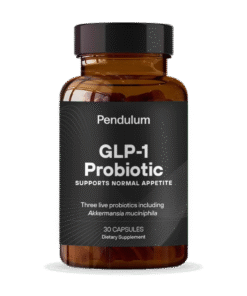
Pendulum GLP-1 Probiotic
Contains Akkermansia muciniphila and Clostridium butyricum, specifically formulated to stimulate GLP-1 production.
When this makes sense:
- Food cravings are a significant problem
- Appetite dysregulation interferes with metabolic goals
- You’re looking for natural GLP-1 support without pharmacological intervention
GLP-1 (glucagon-like peptide-1) is a hormone that signals fullness, slows stomach emptying, and supports insulin secretion. Akkermansia secretes a protein called P9 that stimulates GLP-1 production. Clostridium butyricum increases GLP-1 in a dose-dependent manner through butyrate production.
Preclinical studies show this mechanism works. A consumer study of 274 people found that this formulation reduced overall food cravings by 91%, with significant reductions across all categories tested — sweets (88%), carbohydrates (87%), fast food (85%), and high-fat foods (82%).
This isn’t a weight loss drug. It’s a targeted probiotic intervention that works through the gut-brain axis to influence appetite signalling. If cravings are derailing metabolic progress despite stable blood sugar, this formulation addresses a different mechanism than standard Akkermansia supplementation.
Which Formulation Makes Sense?
The decision comes down to clinical priority:
- Gut barrier focus → Akkermansia
- Metabolic health broadly → Metabolic Daily
- Appetite regulation specifically → GLP-1 Probiotic
You can also layer these strategically. Some people start with Metabolic Daily to address foundational metabolic and barrier issues, then add GLP-1 Probiotic if cravings remain problematic once other parameters stabilise.
All three are shelf-stable and designed for Australian conditions. All use live Akkermansia with demonstrated viability through the supply chain.
How Akkermansia Fits into a Broader Supplement Strategy
We think about supplements as tools within a sequence — not solutions in isolation.
A simplified framework:
- Foundations — digestion, tolerance, basic nutrient status
- Targeted support — addressing specific imbalances
- Refinement — mechanism-specific tools like Akkermansia
Akkermansia usually belongs in stages 2 or 3. If digestion is chaotic or inflammation is uncontrolled, it’s not the right starting point. If foundations are stable and the context fits, it can be introduced earlier.
The guiding principle is clarity: knowing what you’re addressing, and why.
For a more detailed discussion of how to think about supplement sequencing, see our guide on How to Think About Supplements.
Our Approach at Fairfield Nutrition
We stock Pendulum because it’s the most reliable Akkermansia formulation we’ve found for use in Australia.
If the clinical picture suggests gut barrier or metabolic issues, and none of the contraindications apply, Akkermansia can be worth exploring – Akkermansia is a ‘keystone bacteria’ and boosting it’s numbers or introducing it in the first place can be very helpful.
The decision comes down to context, timing, and safety — not headlines about “the next big gut bacteria.”. I hope this article helps you decide if it’s right for you.