
Should you be using AI to manage your health in 2026?
ChatGPT, Claude, and other AI language models are increasingly used for health questions, from interpreting symptoms to researching supplements, and they can be incredibly powerful in doing this.
But there’s a critical difference between using AI to build your understanding and using it to replace your judgement. This guide shows you how to prompt AI tools effectively for health decisions without outsourcing your thinking, to get the best results and educate yourself in the process.
The Understand stage of the Fairfield Framework is the hardest to navigate alone.
Noticing that something is off is usually the easy part — your body tends to make itself known eventually. And once you know what you’re trying to address, finding supplements or strategies to try isn’t difficult. But the step in between — building enough understanding of what’s actually driving what you’re experiencing before deciding what to do — is where most people get stuck.
It’s the stage with no obvious entry point. There’s no aisle in the health food shop labelled “understanding”. And while practitioners, functional testing and good educational content all help, they’re not always the right first step for everyone.
This is where AI can genuinely earn its place.
Language models like ChatGPT and Claude are now part of how people think about health. Used well, they reduce cognitive load, help you ask better questions, and make the Understand stage feel navigable rather than overwhelming. Used poorly, they quietly replace your judgement with something that sounds confident but has no skin in the game.
The difference isn’t about tech literacy. It’s about the role you give the tool.
1. The Golden Rule: Treat AI as your research assistant, not your doctor
Here’s the simplest way to think about using AI for health:
Treat it like a researcher helping you prepare for a meeting with your doctor — not as the doctor themselves.
This changes everything about how you prompt.
Wrong framing (AI as doctor):
- “What should I take for my symptoms?”
- “Diagnose what’s wrong with me”
- “Tell me if I need to see someone”
Right framing (AI as research assistant):
- “Help me understand what commonly causes these symptoms”
- “What questions should I ask my doctor about this?”
- “What information would be useful to track before my appointment?”
The research assistant model keeps you in the right relationship with the tool: it’s helping you prepare, organise your thinking, and understand your options — but you’re still the one making decisions, and your practitioner is still the one with expertise, examination capability, and accountability.
This is what the Understand stage is actually asking of you: not to arrive at certainty, but to build enough context to make better decisions. AI, used this way, is a practical tool for doing exactly that.
This principle underlies everything else in this article.
2. Stop seeking immediate answers, start asking the right questions..
The most common mistake people make in the Understand stage is jumping straight to “what should I do?” before they’ve spent enough time asking “what might be going on?”
AI reflects this back immediately. Ask it for a solution and it’ll give you one — confidently, plausibly, and without any real knowledge of your situation. Ask it to help you understand the territory first and you’ll get something far more useful.
Prompts that erode agency:
- “What should I take for X?”
- “What’s the best protocol?”
- “Just tell me what to do”
Prompts that build understanding:
- “What factors do people typically consider when addressing X?”
- “What trade-offs exist between approaches A and B?”
- “What would signal that escalation is needed?”
- “What are common mistakes people make when interpreting this?”
The difference isn’t length or sophistication. It’s who remains in the decision-making seat.
The first set outsources judgement. The second builds it.
Examples:
Instead of: “What supplements should I take for fatigue?”
Try: “What are the common causes of fatigue? What would help me figure out which might be relevant to me?”
Instead of: “Is magnesium better than melatonin for sleep?”
Try: “What are magnesium and melatonin each doing for sleep? What makes them suited to different situations?”
Instead of: “Should I take probiotics?”
Try: “What are probiotics actually addressing? What situations would make them more or less relevant?”
You stop collecting instructions and start building understanding. Your research assistant can help you map the territory. You’re the one who decides where to go.
You don’t need perfect prompts to start
The examples in this article range from simple to sophisticated — start where you are.
Instead of: “What should I take for sleep?”
Try: “What factors affect sleep? What would help me work out what’s relevant for me?”Instead of: “Give me a protocol for gut issues”
Try: “What commonly causes gut issues? How would I tell which might apply to me?”As you learn what matters, your prompts will naturally get more specific. The principle stays the same: ask your research assistant for understanding, not instructions.
3. Treat AI as a mirror, not an authority
AI is good at summarising, organising, and surfacing patterns across large amounts of information. It is not good at knowing what’s true in the way a practitioner does — because it has no context, no responsibility, and no consequences if it gets things wrong.
If you catch yourself thinking “ChatGPT says…” rather than “Based on this, I think…” — that’s judgement being outsourced. The Understand stage is about building your own picture, not borrowing someone else’s.
A good tool sharpens your thinking. A bad use of a tool replaces it.
4. Context is what makes AI useful for understanding
Generic questions get generic answers. This is especially true in the Understand stage, where what matters is what’s relevant to you — not what’s generally true about a symptom.
Think about briefing a junior research assistant. The more relevant information you give them, the more useful their work becomes.
What context typically matters:
- Current symptoms and their patterns: Not just “fatigue” but “fatigue that’s worse in the afternoon, improves after eating”
- Relevant health history: Previous diagnoses, tests you’ve done, treatments you’ve tried
- What you’ve already tried: What worked, what didn’t, how you responded
- Your constraints: Dietary restrictions, previous intolerances, budget limitations
- Your timeline: How long has this been happening? Is this acute or ongoing?
Generic prompt:
“What helps with gut health?”
You’ll get a generic list: probiotics, fibre, fermented foods. Your research assistant has nothing specific to work with.
With context:
“I’ve had bloating after meals for about 4 months. I tried probiotics from the chemist with no change. I don’t do well with dairy. What commonly causes bloating like this? What would help me narrow down which is most relevant?”
Now your research assistant can consider your symptom pattern, your timeline, what hasn’t worked, and your known constraints. The response becomes genuinely relevant rather than generically correct.
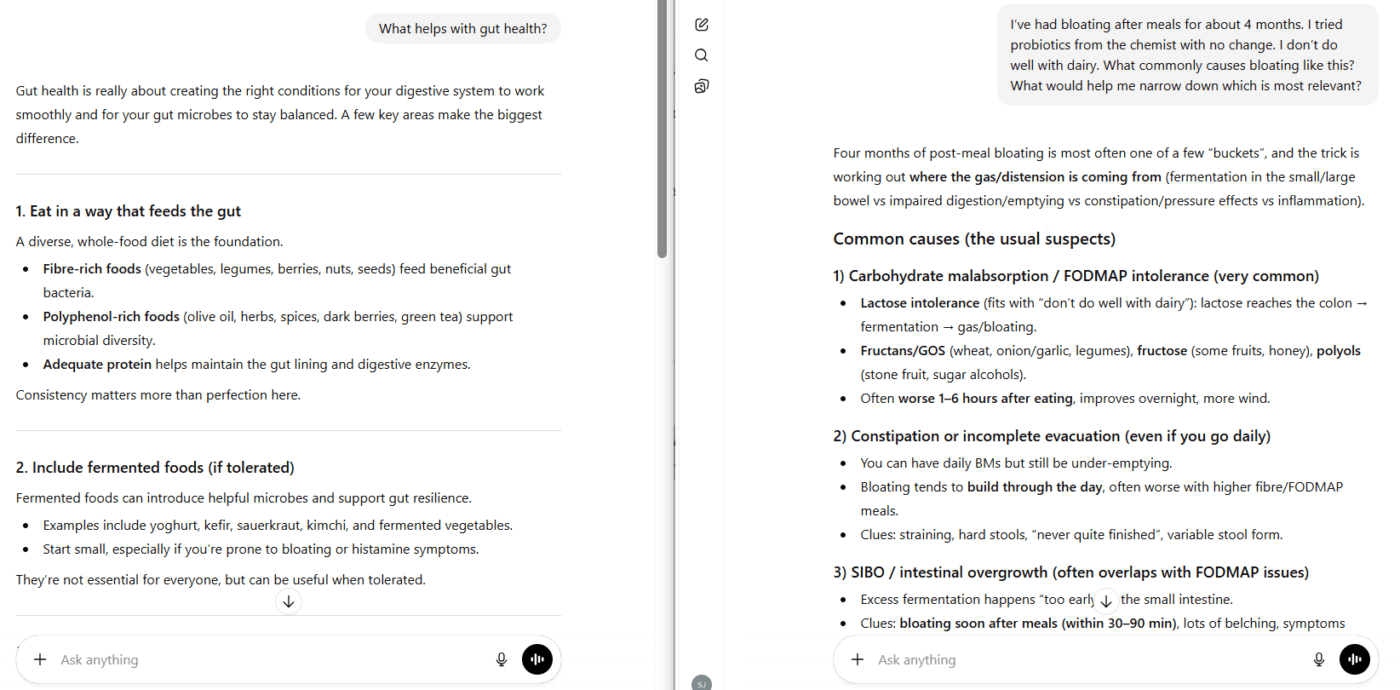
The more context you provide, the more your research assistant can help you actually understand rather than simply inform.
5. Ask questions that build understanding, not answers to follow
Your research assistant should help you understand your options — not choose for them.
For digestive symptoms:
“I get bloating about an hour after meals, especially bigger meals or fatty foods. It’s been about 4 months. What commonly causes this pattern? What would help me understand which is most likely for me?”
For sleep issues:
“I fall asleep fine but wake up around 3am and can’t get back to sleep. It’s been happening most nights for a few months. What usually causes this pattern? What would be worth tracking or observing?”
For energy problems:
“My energy crashes in the afternoon, especially if I skip lunch. I sleep okay but don’t wake up feeling refreshed. What patterns cause this? What would help me work out what’s going on?”
Notice these prompts include basic context (timing, pattern, duration), ask for understanding rather than instructions, and frame AI as a research assistant rather than a decision-maker. They’re also simple enough that anyone can write them — you don’t need to be health-literate to start.
Building on previous conversations:
If you’re having an ongoing conversation, reference what you’ve discussed before:
“I tried the low-sugar breakfast approach we talked about. The afternoon energy crash is better but I’m still not waking up refreshed. What does that tell us? What would be worth looking at next?”
This lets your research assistant help you interpret your response to changes — which is often more valuable than the initial suggestion, and is a genuinely useful way to move through the Understand stage over time.
6. Use AI to slow you down, not speed you up
One of the hidden risks of AI is premature action — and premature action is precisely what the Understand stage is designed to interrupt.
When something feels urgent or confusing, speed can feel reassuring. But in health especially, fast answers are often worse than thoughtful ones. The supplement you order on Tuesday because an AI gave you a confident-sounding protocol is rarely the result of genuine understanding.
Your research assistant is useful when they help you:
- Map the problem more clearly
- See what you don’t yet understand
- Identify what actually deserves attention
They’re being misused when they:
- Push you toward buying things before the problem is clear
- Create urgency where patience would be wiser
- Make you feel productive without actually building understanding
Poor approach:
“Give me a supplement protocol for fatigue, brain fog, and gut issues.”
This gets you a shopping list. You’ll feel like you’re taking action. But you’re no closer to understanding what’s actually happening — and the protocol has no way of knowing whether it fits your situation.
Better approach:
“I’m 42 and dealing with fatigue (worse in mornings), brain fog (gets better after eating), and digestive issues (bloating, irregular bowel movements). This has been developing over about 18 months. I eat fairly clean and sleep okay, but don’t wake up refreshed. My GP checked my thyroid 6 months ago and said it was normal. What patterns commonly link these symptoms? What would help me work out which is most relevant?”
This slows you down in a useful way. You’re briefing your research assistant properly so they can help you build a map before choosing a route.
Follow-up prompts that keep the understanding building:
“Of those possibilities, the blood sugar pattern seems to fit best. What would help me test whether that’s what’s going on? What should I be tracking?”
“If I wanted to address blood sugar first, what does that typically involve? How long before I’d know if it’s helping? What would tell me I’m on the wrong track?”
These questions help you think systematically, with clear decision points. Your research assistant is helping you prepare — you’re still the one deciding.
7. Use AI to identify what you don’t know yet
A good research assistant shows you what questions you haven’t thought to ask. In the Understand stage, this is often more valuable than answering the questions you have — because the questions you haven’t thought to ask are usually the ones that matter most.
Before investigating symptoms:
“I’ve been getting afternoon headaches 3–4 times a week for about 6 months. They’re dull pressure, not sharp pain. I’m 38, work at a computer, sleep is okay. What else would a practitioner typically want to know about headaches like this? What am I not thinking to track?”
Before choosing a test:
“I’m thinking about doing a gut test. I have chronic bloating and reflux that’s gotten worse over two years. Probiotics didn’t help. I don’t have severe pain but I’m uncomfortable most days. Would a gut test make sense for this? What would it tell me — and what wouldn’t it tell me? What questions should I ask before deciding?”
Before starting something new:
“I’m thinking of trying magnesium for sleep and muscle tension. I tried a B-complex once and felt anxious and wired. What should I know before starting magnesium? What would tell me if it’s working or causing problems? What questions should I ask a practitioner if I go that route?”
These prompts help you recognise what you’re currently blind to, what variables matter that you hadn’t considered, and — critically — when you’ve reached the limit of what self-investigation can usefully tell you.
Your research assistant is preparing you for better conversations with actual expertise. That’s its job in the Understand stage, and it’s a genuinely useful one.
8. Build context deliberately over time
If you’re going to use AI regularly for health questions, treat it like an ongoing research project rather than a series of one-off queries. Brief your assistant properly, build on what you’ve already established, and let the picture develop.
First conversation — establish basics:
“I’m 45, female, living in Melbourne. I have hypothyroidism (on 100mcg thyroxine for 10 years) and had IBS in my 20s that I mostly manage with diet. Right now I’m dealing with lower energy than I’d like, bloating after most meals despite being gluten and dairy free, and hair thinning over the past year. I sleep about 7 hours but don’t wake up refreshed.”
Next question — reference that context:
“Given what I shared about my thyroid and symptoms, could the hair thinning be thyroid-related? What would help me tell? What questions should I ask my doctor about testing beyond TSH?”
Build on it:
“I got my thyroid results back. TSH is 2.1 (my doctor says that’s fine), but I asked for the full panel. My fT4 is mid-range and fT3 is in the lower third. Does this fit with my symptoms of fatigue, hair thinning, and not waking refreshed? What would be useful to discuss with my doctor about this pattern?”
Your research assistant can start connecting patterns across your symptoms and responses — much like a practitioner would over multiple appointments. But remember: they’re helping you prepare. The practitioner is still the one with expertise, examination capability, and accountability.
Practical note: Most AI tools don’t remember between separate conversations unless you use their memory features (ChatGPT’s memory or Claude’s Projects, for example). If you’re starting a new conversation, include the relevant context again — or bookmark a useful conversation so you can return to it. Claude’s Projects feature in particular is worth exploring if you want to build a persistent health research context over time.
9. Know when your research assistant has done their job — and what comes next
AI can take you a long way through the Understand stage. But it has real limits, and recognising them is part of using it well.
There are clear signals that more AI research isn’t the answer:
- Symptoms are getting worse despite reasonable self-directed changes
- You’re more confused now than when you started
- You keep asking similar questions hoping for different answers
- You’re using AI to avoid seeing a practitioner when you know you should
- The amount of explaining required to get useful answers suggests this is beyond self-investigation
When any of these are true, your research assistant has done their job. They’ve taken you as far as self-investigation can go. What you need now is a different kind of tool.
Ask yourself:
- Has my research assistant helped me get clearer, or am I just collecting more information?
- Would testing or professional assessment actually answer this, or am I hoping more research will?
- Am I avoiding something I know I should do?
- Is this getting more complex rather than simpler?
- Do I have enough clarity now to have a productive conversation with a practitioner?
If the answers point toward avoidance or confusion, it’s time to escalate. And the good news is that using AI well through the Understand stage means you’ll arrive at that next step far better prepared than most people do.
The four tools available to you in the Understand stage — and when each one makes sense:
| Tool | Best used when | Where to start |
|---|---|---|
| AI as research assistant | You’re in early investigation mode, organising your thinking, or preparing for a conversation with a practitioner or test result interpretation | This article — start with section 2 |
| Educational content | You want practitioner-curated context on a specific area — how to think about gut symptoms, sleep, hormonal patterns — rather than generic information | Our Learn section |
| Functional lab testing | You’ve identified a pattern worth investigating properly and need data to move from “I suspect something” to “here’s what’s actually happening.” Includes a single interpretation consultation. | Lab Testing |
| Practitioner support | The contributing factors are multiple, interconnected, or unclear enough that no test or article is going to resolve the picture alone. You’ve been stuck for a while and need genuine expertise applied to your whole situation. | Health Unlimited Program |
The goal across all four isn’t to collect more information. It’s to build enough genuine understanding to make your next decision a better one — whether that’s a supplement, a test, a lifestyle change, or simply continuing what’s already working.
Responsibility never transfers to the AI
No system — AI or human — carries the consequences of your health decisions except you.
That doesn’t mean doing everything alone. It means staying the one who decides when to act, when to wait, and when to get help. The Understand stage is ultimately about building your own capacity to navigate health decisions — not creating a new dependency on a tool that sounds authoritative but carries no responsibility.
A research assistant makes your decisions clearer. They don’t make the decisions for you.
Even with perfect context, your AI research assistant:
- Isn’t accountable for outcomes
- Can’t examine you
- Can’t order tests
- Doesn’t carry any risk if things go wrong
- Doesn’t replace the expertise of a practitioner when expertise is actually needed
Context makes AI a better research assistant. It doesn’t make it a substitute for expertise when expertise is genuinely what’s needed. Knowing the difference is itself a form of health literacy — and it’s one of the things the Understand stage is designed to develop.
Advanced prompts: when simple isn’t enough
Once you’re comfortable with basic contextual prompting, you can give your research assistant more detailed briefs. These are most useful when you’ve moved through early investigation and need more precision — particularly when interpreting test results or preparing for a practitioner conversation.
Advanced digestive symptom prompt:
“I’m experiencing bloating 30–60 minutes after meals, particularly after larger meals or those with more fat. This has been happening for about 4 months. I haven’t had my gallbladder removed and I don’t have diagnosed SIBO, though I haven’t been tested. My bowel movements are generally normal but occasionally loose. No blood, no severe pain, no unintentional weight loss. I’m 40, female, no other diagnosed conditions, not on medications except occasional ibuprofen. What are the main categories of factors that can contribute to post-meal bloating with this pattern? For each category, what would help narrow down whether it’s relevant in my case? What would a practitioner typically want to know beyond what I’ve shared? What patterns would suggest it’s time to test rather than continue investigating on my own?”
Advanced lab interpretation prompt:
“I have a GI-MAP result showing elevated Klebsiella pneumoniae at 10^8, along with low Akkermansia muciniphila (below detection) and Faecalibacterium prausnitzii at 10^6 (reference range 10^9–10^11). I’ve had ongoing fatigue for 18 months — worse in the afternoon — and joint stiffness in my hands and knees that’s worse in the morning and improves with movement. No diagnosed autoimmune conditions but my mother has rheumatoid arthritis. I’m 38, eat a whole foods diet, limited processed foods. What contexts make elevated Klebsiella at this level clinically significant versus incidental? How does the pattern of low beneficial bacteria combined with my symptoms and family history change the interpretation? What questions should I be asking a practitioner about these results? What other markers would help confirm or challenge the significance?”
Advanced supplement decision prompt:
“I’m considering starting methylfolate and methylB12 for support with chronic fatigue and difficulty recovering from exercise. I have MTHFR C677T homozygous (confirmed via 23andMe, verified with clinical testing). I tried a B-complex about 3 years ago (contained 400mcg folic acid and 100mcg B12) and within 2 days felt overstimulated, anxious, and had difficulty sleeping — symptoms resolved when I stopped. I’m 45, female, no other diagnosed conditions, currently taking magnesium glycinate 300mg at night and vitamin D 2000IU daily. What’s the mechanistic difference between supporting methylation with methylfolate versus folinic acid? Given my MTHFR genotype, previous adverse response to B-vitamins, and current supplement regimen, what factors influence which approach might be better tolerated? What would be a conservative starting approach? What should I be tracking to know if it’s working or causing problems?”
What makes these advanced:
- Precise symptom characterisation: Timing, triggers, quality, duration, associated symptoms
- Comprehensive relevant history: Previous tests, diagnoses, treatments, responses, family history
- Specific exclusions: What you’ve ruled out, what you haven’t tested
- Current interventions: Everything you’re currently doing
- Detailed constraints: Specific intolerances, previous adverse reactions, medications
- Practitioner-oriented questions: “What should I ask my practitioner?” keeps the research assistant in its proper role
When to use advanced prompts:
- When simple prompts have gotten you oriented but you need more precision
- When interpreting complex test results before discussing with a practitioner
- When you have a detailed history that’s directly relevant
- When previous interventions have given you information worth incorporating
- When you want to prepare thoroughly for a practitioner appointment
When not to use them:
- When you’re just starting to investigate something
- When simpler prompts would get you to the same place
- When the complexity is making you more confused rather than more clear
- When you’re using complexity to avoid admitting you need actual expertise
The progression through the Understand stage looks like this:
Start simple → Get oriented → Build context → Add detail as it becomes relevant → Use advanced prompts when precision matters → Escalate to testing or practitioner support when your research has done its job
Most questions don’t need advanced prompts. But when they do, the additional context and specificity can help your research assistant prepare you more thoroughly for the conversations and decisions that follow.
Remember: Even the most advanced prompting doesn’t replace expertise. It prepares you to use expertise more effectively. And that — building your own capacity to navigate health decisions with greater clarity and confidence — is what the Understand stage is really for.
ChatGPT and other AI tools aren’t doctors and don’t provide medical advice. They’re useful as research assistants—helping you understand patterns, organize your thinking, and prepare for conversations with practitioners. They should never replace professional medical assessment.
Ask for frameworks rather than prescriptions. Instead of “What should I take for fatigue?” ask “What commonly causes fatigue? What would help me determine which is relevant?” This builds understanding rather than creating dependency.
AI can help you understand different supplements, their mechanisms, and trade-offs but shouldn’t make the decision for you. Use it to research and prepare questions, then make decisions based on your full context, history, and ideally with practitioner guidance.
Yes. The research assistant approach works across all AI language models – ChatGPT, Claude, Gemini, and others. The principles of asking for frameworks, providing context, and maintaining your judgement apply regardless of the specific tool.
When symptoms worsen despite self-directed changes, when you’re more confused than when you started, when you’re asking repetitive questions without progress, or when the complexity suggests you need professional assessment rather than more research.
Our position
AI can be genuinely useful when it helps people think more clearly, understand their options, and navigate complexity with confidence.
It becomes harmful when it creates dependency, loss of your individual agency, or the illusion of certainty.
We design our work, and any future tools, around that line. This article was written collaboratively with AI, using exactly the principles we describe: treating it as a research assistant that builds understanding, not one that replaces judgement.
The research assistant model is the difference.
When AI functions as a research assistant helping you prepare, and increasing your knowledge and broadening your way of thinking, it builds your up. When it’s treated as the perfect expert giving you all answers, it erodes judgement.
The quality of the model matters less than the role it plays in your decision-making. Whether you’re using ChatGPT, Claude, or another AI tool, the research assistant model keeps you in the right relationship with the technology.
If you’re working through a complex health situation and want support that keeps you in the driver’s seat while providing real expertise, you may also want to explore our Health Unlimited program.