“Pure Encapsulations O.N.E. Multivitamin (60 caps)” has been added to your cart. View cart
Supplement Strategy 101
Before you even start to supplement, consider this:
Before we think about supplements, it’s important to acknowledge something that often gets skipped.
Supplements cannot compensate for chronic issues in diet, lifestyle, or environment.
They can support the body, but they can’t override persistent stressors.
Areas that matter most include:
Sleep quality and timing
Food choices and consistency
Regular movement
Stress load and recovery
Light exposure and daily rhythms
Mold, toxins and environmental stresses
When these are significantly out of balance, adding more supplements usually leads to:
diminishing returns
temporary effects
or a sense of “nothing really working”
This doesn’t mean everything has to be perfect before supplements are useful. It does mean that supplements work best when these foundations are at least reasonably supported.
Think of supplementation as something that layers onto a functioning system, not something that fixes one that’s under constant strain.
Step 1: Choose what you’re trying to support
Before choosing a supplement, it’s usually more useful to get clear on what you’re trying to support.
For most people, this falls into one of three areas:
Sleep, stress, & foundations
Support for recovery, nervous system, and the ability to switch off
If you’re unsure, just pick the one that feels most relevant – You don’t need to solve everything at once.
Once you’ve chosen a starting point, the next step is simply deciding how much support is appropriate.
Step 2: Choose the level of support
Choosing the level of support is about finding the simplest support that actually makes sense for you.
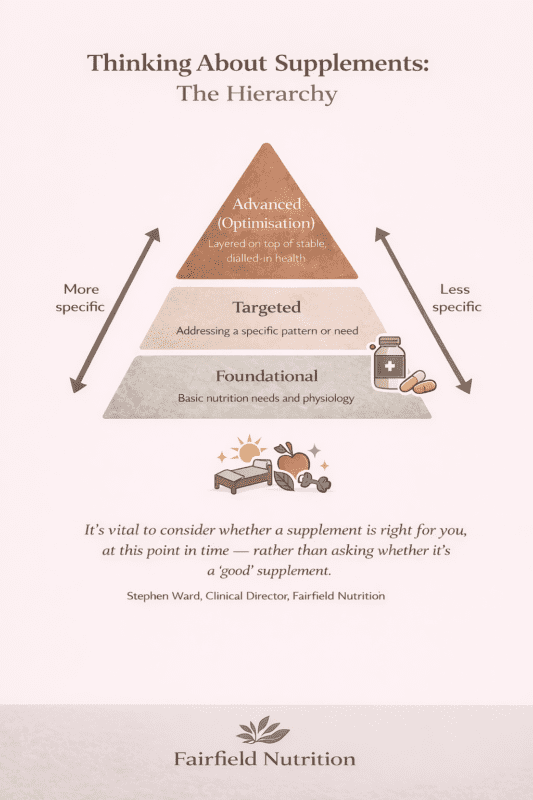
At Fairfield Nutrition, we think about supplements as a hierarchy, not a checklist:
Foundational supplements
Supporting the basics everything else depends on
Foundational supplements support core processes that apply broadly across the body.
They don’t target a specific issue – Instead, they help the body function more reliably in the background.
Within any category, this is usually the best place to begin — especially when the pattern is broad or unclear.
Foundational support often includes:
Minerals and nutrients that are commonly low or poorly absorbed
Broad support for energy production, nervous system function, or digestion
Simple formulations designed for consistent, ongoing use
Examples might include:
Magnesium
Omega-3 (EPA/DHA)
Vitamin D3 with K2
Zinc
B vitamin complex
Basic gut support such as enzymes or probiotics
These products are often the least exciting — and the most important. If foundations are inconsistent, adding more specialised products on top rarely produces lasting results.
This product has multiple variants. The options may be chosen on the product page
Advanced supplements
More specialised, but not necessarily “better”
Advanced supplements are often misunderstood – They are not necessarily stronger or more effective
In many cases, they are used once the basics are already working well — not when something is clearly out of balance. This category is best thought of as optimisation-focused rather than corrective.
Advanced support tends to make sense when:
core nutrition is adequate
lifestyle and recovery are reasonably stable
there are no obvious deficiencies or unresolved issues
the goal is to refine or maintain how you feel
Examples of this might include:
supporting healthy ageing or longevity pathways
refining energy, recovery, or cognitive performance
improving resilience or exercise response
They tend to work best when layered onto a stable baseline — not used to fix something that is still clearly under strain.
Symptoms → add a targeted supplement Partial relief → add another Plateau → add something “stronger”
Over time, this often results in:
long supplement lists
higher monthly spend
less confidence about what’s actually helping
The goal isn’t to keep adding more. The goal is to use the lowest level that meaningfully supports you, and only move up the hierarchy when there’s a clear reason.
A simpler way to use this framework
You don’t need a complex protocol. Instead, a useful way to approach supplementation is:
Choose the area you want to support
Start with the lowest level that makes sense
Stay consistent before adding anything else
Adjust only when there’s a clear reason
If you’re unsure, it’s usually better to step down a level — not up.
What to do next
If you’re unsure where to begin, start here:
Sleep & Stress → for recovery and nervous system support

 Pure Encapsulations O.N.E. Multivitamin (60 caps)
  Pure Encapsulations Vitamin D3 1000IU 60 Caps
$24.80
Pure Encapsulations Vitamin D3 1000IU 60 Caps
$24.80 Pure Encapsulations Magnesium Glycinate
Price range: $43.80 through $84.20
Pure Encapsulations Magnesium Glycinate
Price range: $43.80 through $84.20 Microbiome Labs MegaSporeBiotic
Price range: $92.80 through $234.00
Microbiome Labs MegaSporeBiotic
Price range: $92.80 through $234.00