
A practical guide to choosing the right probiotic category
Choosing a probiotic should be straightforward.
Instead, many people find themselves comparing CFU counts, strain numbers, refrigeration requirements and marketing claims—without really knowing which differences matter.
Part of the problem is that we often talk about probiotics as though they’re all the same.
They’re not.
The word “probiotic” doesn’t describe a single type of supplement. It describes a broad collection of bacteria, beneficial yeasts and microbiome-support approaches that can behave quite differently from one another.
Some probiotics contain traditional bacterial strains such as Lactobacillus and Bifidobacterium. Others use spore-forming bacteria. Some are beneficial yeasts such as Saccharomyces boulardii, while others combine probiotics with prebiotic fibres.
They’re all probiotics.
They’re simply different tools, developed with different purposes in mind.
This is one reason why people’s experiences with probiotics vary so much. Sometimes the issue isn’t that a probiotic doesn’t work—it’s that the category wasn’t well matched to what the person was trying to achieve.
Rather than asking:
“What’s the best probiotic?”
a more useful question is:
“What type of probiotic makes the most sense for my current situation?”
That single shift in thinking changes the conversation completely.
It’s also worth remembering that a probiotic isn’t always the next step.
If digestive symptoms are being driven primarily by factors such as poor sleep, chronic stress, inadequate fibre intake, digestive capacity, or other underlying influences, changing probiotic categories may make little difference. Sometimes understanding why symptoms are occurring is more valuable than simply changing supplements.
That’s the approach we’ve tried to take throughout this guide. Rather than telling you which probiotic is “best”, the aim is to help you understand the different categories, the situations they’re commonly discussed in, and the questions worth asking before deciding whether a probiotic is the right tool in the first place.
Why probiotic conversations become confusing
Imagine asking someone:
“What’s the best vehicle?”
There isn’t a meaningful answer.
A bicycle. A family SUV. A tractor. A racing car.
They’re all vehicles, but each is designed for a different purpose. Without knowing what you’re trying to do, the word best has very little meaning.
Probiotics work much the same way.
Some categories are commonly discussed after antibiotics. Others are chosen because they behave differently during digestion. Some are designed to support broader microbiome diversity, while others tend to feature in more targeted gut health approaches.
Comparing products purely on CFU count, the number of strains or price often overlooks the more important question:
Is this the right type of probiotic for my current situation?
Understanding the different categories won’t tell you exactly which product to buy. It will help you ask better questions and make more intentional choices — rather than defaulting to whatever promises the most bacteria.
How practitioners often think about probiotics
One of the biggest misconceptions in gut health is that probiotic selection is mostly about finding the strongest product, the highest CFU count or the blend with the most strains.
In practice, the thought process is usually more contextual.
Rather than going straight to the label, a practitioner is usually asking:
- What is the person hoping to achieve?
- What does their digestive history suggest?
- How reactive or sensitive is their gut?
- Have they recently taken antibiotics?
- Have they tried probiotics before, and what happened?
- Is the digestive environment likely to support this category of probiotic?
These questions don’t always produce a single correct answer, but they help narrow the field considerably.
That’s why two people with seemingly similar digestive symptoms may receive completely different probiotic recommendations.
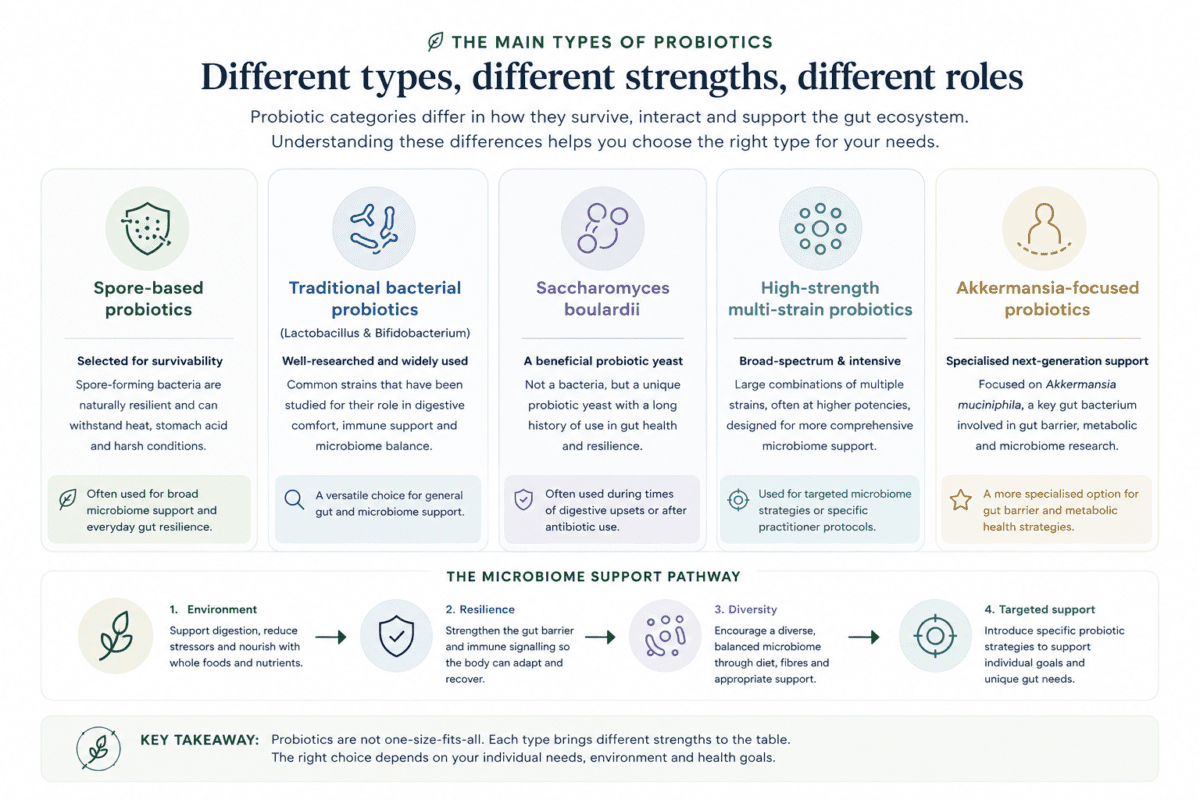
The main probiotic categories
The aim of this guide isn’t to convince you that one probiotic category is better than another. It’s to help you understand how the main categories differ, when each is commonly discussed, and why practitioner recommendations often vary.
Once you understand the categories, product comparisons become much easier to interpret.
Below, each category is explained in plain terms, along with the situations where it’s most commonly considered.
| Probiotic category | What makes it different | Often discussed when | Key consideration |
|---|---|---|---|
| Spore-based probiotics | Designed for survivability through digestion | Broader microbiome and gut-environment support | Often introduced gradually |
| Lactobacillus & Bifidobacterium blends | Traditional bacterial probiotic strains | General digestive and microbiome support | Strain selection matters |
| Saccharomyces boulardii | Beneficial probiotic yeast | Post-antibiotic and digestive resilience support | Functions differently from bacteria |
| High-strength multi-strain probiotics | Larger and more targeted bacterial blends | More intensive microbiome support approaches | Tolerance and storage matter |
| Synbiotics & prebiotic-supported probiotics | Combine organisms with microbial-support fibres | Supporting the wider gut ecosystem | Fibre tolerance varies considerably |
1. Spore-based probiotics
Spore-based probiotics have become increasingly prominent within practitioner-grade gut health because they behave differently from many traditional bacterial probiotics.
Rather than existing in a fragile, active state, these organisms spend part of their life cycle in a protective spore form, allowing them to tolerate stomach acid, bile and other environmental stressors before becoming metabolically active later in the digestive tract.
This is one of the characteristics that distinguishes them from many traditional probiotic strains.
It doesn’t automatically make them “better”. It makes them different.
The more useful question isn’t whether spore-based probiotics are superior to other categories. It’s whether this category is a good match for what you’re currently trying to achieve.
When are spore-based probiotics commonly discussed?
Practitioners often consider spore-based probiotics as part of broader microbiome support strategies, particularly when the goal is supporting the overall gut ecosystem rather than simply introducing large numbers of traditional bacterial strains.
They also tend to be discussed after periods that may have disrupted the gut microbiome, such as a course of antibiotics, although recommendations vary depending on the individual, their digestive history and the broader clinical picture.
Rather than thinking of spore-based probiotics as a stronger version of a traditional probiotic, it’s generally more helpful to think of them as a different category with a different way of interacting with the gut environment.
Practical characteristics
Although individual products vary, spore-based probiotics often share several practical characteristics:
- They exist in a protective spore form before becoming metabolically active in the digestive tract
- Many products are shelf stable and tolerate heat and storage conditions well
- They’re commonly introduced gradually, particularly in people with more sensitive digestion
- They’re often considered as one component of a broader gut health strategy rather than a standalone solution
As with all probiotic categories, responses vary between individuals. Some people tolerate spore-based probiotics well from the outset, while others benefit from a slower introduction or a different category altogether.
Spore Probiotics vs Conventional Probiotics
A deeper comparison of how spore-based probiotics differ from traditional Lactobacillus and Bifidobacterium blends.
Guide coming soon
Triple Probiotic Therapy
How different probiotic categories may be layered together in more advanced gut-support approaches.
2. Lactobacillus and Bifidobacterium probiotics
When most people think of a probiotic, they’re usually thinking of Lactobacillus and Bifidobacterium.
These bacterial groups have been studied for decades and appear in many fermented foods, yoghurts and probiotic supplements.
Despite often being grouped together, this isn’t a single probiotic. Lactobacillus and Bifidobacterium each contain many different species, and within those species are numerous individual strains — each with different characteristics, studied for different purposes.
That’s one reason practitioners often pay much closer attention to the strains within a product than to the number of bacteria listed on the label.
When are Lactobacillus and Bifidobacterium probiotics commonly discussed?
Traditional bacterial probiotics are frequently considered as part of general digestive and microbiome support.
Depending on the strains included, they may be discussed across a wide range of situations — from everyday digestive health through to more targeted gut health strategies.
Because they’re such a broad category, it’s difficult to make sweeping statements about how they behave. Two products may both be described as “Lactobacillus and Bifidobacterium probiotics” while containing completely different strain combinations and being chosen for entirely different reasons.
This is also why research on one strain shouldn’t automatically be assumed to apply to another, even within the same bacterial species.
Practical characteristics
Although formulations vary considerably, traditional bacterial probiotics often share several characteristics:
- Strain selection matters considerably — two products in this category can have quite different characteristics depending on what’s included
- Responses can vary depending on the strains selected and the individual using them
- Some products require refrigeration, while many modern formulations are shelf stable
- They’re commonly used as part of broader digestive and microbiome support strategies
Some people notice meaningful improvements with traditional bacterial probiotics, while others experience bloating, digestive discomfort or find a different probiotic category better suited to their situation.
-
 Metagenics Gut Ultraflora Intensive Care (60 caps)
Login to View Pricing
Metagenics Gut Ultraflora Intensive Care (60 caps)
Login to View Pricing -
 Seeking Health ProBiota Bifidobacterium ( Formerly probiota bifido) - 60 Caps
-
 BioGaia Gastrus Pure Action L-Reuteri Probiotic - 60 capsules
$54.80
BioGaia Gastrus Pure Action L-Reuteri Probiotic - 60 capsules
$54.80
3. Saccharomyces boulardii
One of the biggest surprises for many people is that not all probiotics are bacteria.
Saccharomyces boulardii is a probiotic yeast.
That distinction matters because it behaves differently from bacterial probiotics such as Lactobacillus and Bifidobacterium, and is often discussed separately within practitioner-style gut health approaches.
Rather than thinking of Saccharomyces boulardii as a stronger or “better” probiotic, it’s more accurate to think of it as a different category — with its own characteristics and a different way of interacting with the gut environment.
When is Saccharomyces boulardii commonly discussed?
Saccharomyces boulardii is commonly recommended around microbiome support following antibiotics, digestive resilience and broader gut restoration strategies.
It may also be used alongside bacterial probiotics rather than instead of them, depending on the individual and the overall approach being considered.
As with every probiotic category, the most appropriate option depends on what you’re trying to achieve and the wider digestive context.
Practical characteristics
Although products vary, Saccharomyces boulardii is often recognised for several distinguishing characteristics:
- As a yeast, it is naturally unaffected by antibiotics, which influences when and how it is sometimes used
- It is frequently discussed as part of post-antibiotic and broader gut restoration strategies
- It may be used alongside bacterial probiotic categories in some practitioner-style approaches rather than as a replacement
- Responses vary between individuals, as with all probiotic categories
Understanding that Saccharomyces boulardii belongs to a completely different probiotic category helps explain why recommendations sometimes vary. A practitioner isn’t necessarily choosing between a “good” probiotic and a “better” one — they may simply be choosing between different biological approaches.
-
 myBrainCo Gut Repair - 300g Powder
Original price was: $59.80.$54.80Current price is: $54.80.
myBrainCo Gut Repair - 300g Powder
Original price was: $59.80.$54.80Current price is: $54.80. -
 Bioceuticals SB Floractiv 500 (30 caps)
Original price was: $46.95.$42.25Current price is: $42.25.
Bioceuticals SB Floractiv 500 (30 caps)
Original price was: $46.95.$42.25Current price is: $42.25. -
Metagenics Gut Ultraflora Intensive Care (60 caps)
Login to View Pricing
-
 Bioceuticals SB Floractiv
Price range: $29.25 through $51.80
Bioceuticals SB Floractiv
Price range: $29.25 through $51.80
Why this distinction matters
One of the biggest misconceptions in probiotic discussions is treating all probiotics as interchangeable. In reality, bacterial probiotics, probiotic yeasts and spore-based organisms may behave very differently depending on survivability, fermentation behaviour, gut tolerance and the wider digestive environment.
4. High-strength multi-strain probiotics
Some probiotic products are designed around larger numbers of bacterial strains, higher CFU counts, or both.
These products are often described as “high potency”, but it’s worth remembering that potency isn’t simply a matter of how many bacteria are contained in a sachet or capsule.
More bacteria doesn’t automatically mean a better probiotic.
Like every probiotic category, these formulations have characteristics that may make them more or less appropriate depending on the individual and what they’re trying to achieve.
When are high-strength multi-strain probiotics commonly discussed?
High-strength multi-strain probiotics are often considered when practitioners are looking for broader bacterial diversity or more intensive probiotic formulations.
That doesn’t mean they’re the right place for everyone to start.
For some people, they may be a good fit. For others — particularly those with sensitive digestion or previous difficulty tolerating probiotics — a more gradual approach or a different probiotic category may make more sense initially.
The goal isn’t to choose the probiotic with the highest CFU count. It’s to choose a formulation that’s appropriate for the person and the situation.
Practical characteristics
Although individual formulations vary considerably, high-strength multi-strain probiotics often share several characteristics:
- They contain a broader range of bacterial strains than many standard probiotic formulations
- Storage requirements vary — some products require refrigeration, which is worth checking before purchasing
- They’re commonly discussed as part of more targeted or intensive microbiome support strategies
- Tolerance varies between individuals, and some people benefit from a more gradual introduction regardless of the potency on the label
Triple Probiotic Therapy
How high-strength probiotics may fit into broader layered microbiome support strategies.
Why Probiotics Can Make People Feel Worse
Understanding reactivity, bloating, histamine-type symptoms and probiotic tolerance.
Guide coming soon
6. Synbiotics and prebiotic-supported probiotics
Most probiotic categories focus on introducing beneficial microorganisms.
Prebiotics and synbiotics take a slightly different approach by asking:
“How can we better support the microorganisms that are already there?”
Prebiotics are ingredients — typically specific types of fibre — that help nourish beneficial gut microbes already present in the gut. Synbiotics combine probiotics with prebiotic ingredients, designed to work together rather than separately.
The goal isn’t simply to add more bacteria. It’s to support a healthier gut ecosystem.
When are they commonly discussed?
Prebiotics and synbiotics are often considered as part of broader microbiome support, rather than as a direct alternative to taking a probiotic.
Different prebiotic fibres — such as PHGG (partially hydrolysed guar gum) and inulin — behave differently in the digestive tract, and tolerance can vary considerably between them. Some people find one type of fibre comfortable while reacting to another, which is one reason “just take a prebiotic” can be as oversimplified as “just take a probiotic”.
Because fibre tolerance varies considerably, some people notice meaningful improvements when prebiotics or synbiotics are introduced gradually, while others initially experience bloating, gas or digestive discomfort.
Like every approach in this guide, more isn’t automatically better. The right type and amount of prebiotic support depends on the individual and what they’re trying to achieve.
Practical characteristics
- Prebiotics nourish existing gut bacteria, while synbiotics combine probiotics with prebiotic ingredients in a single formulation
- Different prebiotic fibres behave differently in the gut — tolerance for one type doesn’t necessarily predict tolerance for another
- Fibre tolerance varies considerably between individuals, more so than with most probiotic categories
- Often introduced gradually and in smaller doses initially, particularly in people with sensitive digestion
A useful rule of thumb
If someone reacts poorly to probiotics, the answer is not always to try a stronger product. It may be worth thinking about dose, timing, digestive capacity, fibre tolerance, histamine sensitivity and whether the gut environment is ready for that category of support.
How practitioners often think about choosing probiotic categories
One of the biggest misconceptions in gut health is that choosing a probiotic is simply a matter of finding the “best” product, the highest CFU count or the blend with the most strains.
In practice, the thought process is usually much more contextual.
Rather than starting with the product, practitioners often start with the person. Questions might include:
- What is the person hoping to achieve?
- Have they used probiotics before, and how did they respond?
- Is their gut generally resilient, or are they highly reactive?
- Has something recently changed — a course of antibiotics, an illness, a period of stress?
- Are other factors, such as digestive capacity or fibre tolerance, likely to be influencing how they’ll respond?
The answers don’t always point towards the same probiotic category.
Sometimes they suggest starting with a gentler approach. Sometimes they suggest introducing support gradually. Occasionally they suggest that a probiotic isn’t the next priority at all.
A few examples
If someone is highly sensitive or reactive
A lower dose, a gentler category such as Saccharomyces boulardii, or a more gradual introduction may make more sense than starting with a high-strength multi-strain product.
If someone has already tried several probiotics without success
The issue may not be the probiotic itself. Digestive capacity, stress, bowel motility, fibre tolerance, medications or the broader gut environment may all be influencing how someone responds — which is often where the conversation needs to start instead.
If someone is rebuilding after antibiotics
The discussion may involve more than simply choosing a probiotic. Timing, probiotic category — spore-based and Saccharomyces boulardii are both commonly discussed here — diet, prebiotic support and consistency over time may all become part of the conversation.
The common thread is that practitioners rarely ask:
“Which probiotic is the strongest?”
They’re much more likely to ask:
“What’s the most appropriate next step for this person?”
Where triple probiotic therapy fits
Once the main probiotic categories make sense on their own, a natural next question is whether different categories are ever used together.
Sometimes they are.
The reasoning isn’t simply “more bacteria is better”. It comes from a more practical observation: people respond differently to different categories of probiotics, and it’s rarely obvious in advance which category someone will respond best to.
Rather than guessing and trialling one category at a time, some practitioner-style approaches introduce a spore-based probiotic, a traditional bacterial probiotic and Saccharomyces boulardii together — one from each category. If a particular component isn’t well tolerated, or doesn’t seem to be contributing, it can be identified and removed, while the others continue.
There’s also clinical evidence that combining categories this way can work better than any single category alone, since each appears to support the gut through a different mechanism. Used together, they may have a more meaningful effect than the same organisms used individually.
Related gut and digestion guides
Gut & Digestion Support
Start here for a broader overview of digestion, microbiome support and gut-related supplement categories.
Triple Probiotic Therapy
A deeper practitioner-style framework explaining how different probiotic categories may sometimes be layered together.
Rebuilding the Gut Microbiome After Antibiotics
A practical overview of microbiome recovery, probiotic timing and broader gut restoration support.
Guide coming soon
Spore Probiotics vs Conventional Probiotics
A detailed comparison of survivability, bacterial categories and why probiotic responses can differ so widely.
Guide coming soon
PHGG vs Inulin
Understanding how different prebiotic fibres may behave differently in the digestive system.
Guide coming soon
Final thoughts
The probiotic conversation is often oversimplified.
There isn’t one “best” probiotic, any more than there’s one best vehicle. Different probiotic categories have different characteristics, different strengths, and different situations where they may be worth considering.
Understanding those differences won’t tell you exactly which product to buy.
What it will do is help you ask better questions.
Instead of asking:
“Which probiotic is strongest?”
you can begin asking:
- What am I trying to achieve?
- Which probiotic category is commonly discussed in that situation?
And, perhaps most importantly:
Is a probiotic actually the right next step — or should I be thinking more broadly about my gut health aswell?
In many cases, supporting digestive health involves far more than simply adding bacteria. Diet, stress, sleep, digestive capacity, medications and the wider gut environment can all influence how someone responds to probiotic support.
Our aim isn’t simply to help you choose a probiotic.
It’s to help you understand the different options, recognise when they may be appropriate, and make more informed decisions about your gut health over time.
When probiotic selection starts with understanding rather than marketing, choosing the right product usually becomes much clearer.
Frequently asked questions
These are some of the most common questions people ask when comparing different probiotic categories:
What is the best type of probiotic?
There is no single best type of probiotic for everyone. The most suitable category depends on the person’s digestive context, tolerance, previous responses, diet, health history and goals. This is why it can be more useful to compare different types of probiotics rather than choosing based on popularity alone.
Are spore-based probiotics better than regular probiotics?
Spore-based probiotics are not automatically better, but they are different. They contain bacteria capable of forming protective spores, which helps them survive stomach acid and digestive transit differently from many traditional Lactobacillus and Bifidobacterium probiotics. You can explore our spore-based probiotics for examples of this category.
Is a higher CFU probiotic always stronger?
A higher CFU count does not automatically mean a better probiotic. Strain identity, survivability, formulation, storage, dose and individual tolerance all matter. In some cases, a lower-CFU product with well-selected strains may be more appropriate than a very high-strength probiotic.
Can probiotics make bloating worse?
Some people notice increased bloating, gas or digestive discomfort when starting probiotics or prebiotics. This may relate to dose, timing, fibre tolerance, microbial shifts or the person’s current digestive environment. If someone is very reactive, it may be worth starting with a lower dose or considering whether broader gut and digestion support needs to be addressed first.
What is the difference between probiotics and prebiotics?
Probiotics are live microorganisms used to support the gut microbiome. Prebiotics are fibres or substrates that help support the growth and activity of beneficial microbes already present in the gut. They can be useful, but tolerance varies, especially in people who are sensitive to fermentable fibres.
What is Saccharomyces boulardii?
Saccharomyces boulardii is a beneficial probiotic yeast rather than a bacterial probiotic. It behaves differently from bacterial strains such as Lactobacillus and Bifidobacterium and is often discussed separately in relation to digestive and microbiome support. You can view our Saccharomyces boulardii products here.
Should probiotics be taken during or after antibiotics?
This depends on the product, timing, tolerance and individual situation. Probiotics and antibiotics are often discussed together because antibiotics can affect the gut microbiome, but anyone taking antibiotics should follow the advice of their prescribing practitioner.
Do probiotics permanently colonise the gut?
Many probiotics do not permanently colonise the gut in the way people sometimes imagine. Their benefits may come from temporary interactions with the gut environment, immune signalling, microbial activity and broader ecosystem support rather than permanent replacement of the existing microbiome.
Can probiotics replace diet and lifestyle foundations?
No. Probiotics may be helpful, but they do not replace food quality, fibre tolerance, sleep, stress regulation, digestive capacity and broader lifestyle foundations. They usually work best as part of a wider support strategy. For a broader framework, see our guide to how to think about supplements.